
In the heart of the Włodawa Forests, amid an expansive forest-marsh complex, archaeologists are uncovering the secrets of a remarkable early medieval stronghold.
Located near the village of Kaplonosy Kolonia in Wyryki Commune, Włodawa County, the site—first identified in 2016 through remote sensing analysis—continues to reshape understanding of settlement patterns in eastern Poland.
The discovery was made by G. Mączka of the Voivodeship Office for the Protection of Monuments in Lublin (WUOZ) during an aerial and LiDAR-based survey. Initial interpretations suggested a structure resembling a hillfort, concealed beneath dense woodland and wetlands.
A large-scale reconnaissance expedition in spring 2024 brought together archaeologists to conduct systematic surface surveys, environmental assessments, and preliminary conservation analysis. Their findings were published later that year in Zeszyty Muzealne, issued by the Włodawa Synagogue Complex Museum.
Building on those results, the LWKZ commissioned further non-invasive and minimally invasive research in autumn 2025. The work was formally undertaken by the Lublin-based firm Gorgona Patrycja Piotrowska, alongside a broader interdisciplinary team that will continue investigations.
According to the researchers’ report, the fortified settlement dates from the 10th to 13th centuries. They describe it as “an absolutely unique site on the archaeological map of the Lublin Voivodeship”—a relic of an early medieval defensive complex largely untouched by subsequent human activity. Preserved earthworks, including ramparts and moats, enclose subsurface remains of buildings and cultural layers rich in artefacts.
Geophysical surveys using electrical resistivity did not reveal clear traces of above-ground structures but identified embedded features interpreted as hearths and storage pits. A segmented anomaly pattern suggests remnants of timber box ramparts filled with earth or stone. A distinct break in the eastern rampart likely marks the original gate location.
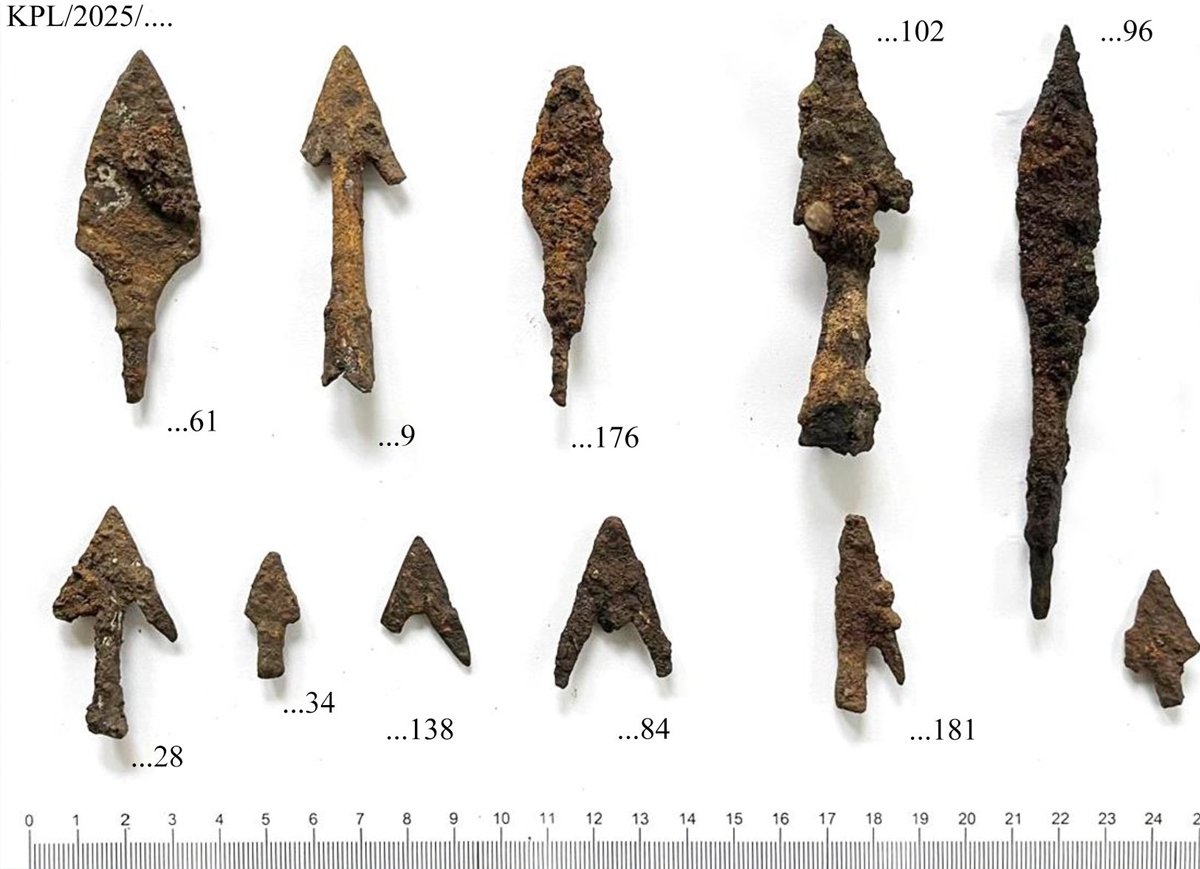
Despite severe logistical constraints—dense undergrowth, fallen trees, marshland access, and strict environmental protections within the Ochoża Forest reserve—the team documented 244 artifacts. These include 66 knives and fragments, fire-strikers, sickles, iron coulters, arrowheads, spearheads, and personal ornaments such as a silver earring and a lyre-shaped buckle.
After its abandonment in the 12th–13th centuries, the stronghold appears to have been reclaimed almost entirely by nature. Sparse traces from World War II hint at its later use as a refuge for Jews hiding from German forces, preserved in local memory.
Hidden among swamps and trees, Kaplonosy Kolonia’s hillfort stands as both an archaeological treasure and a poignant historical landscape—its roots reaching deep into Poland’s early medieval past.