
In this ‘Behind the Paper’ blog post, author Anina Coetzee – a lecturer at Nelson Mandela University, George campus, South Africa – shares the ‘buzz’ about bee avoidance in bird-pollinated flowers! Discussing the research article ‘Is bee-avoidance by bird-pollinated flowers driven by nectar robbing in Erica?‘, Anina delves into the bee-avoidance hypothesis, the beauty of Erica as a study species, and where sci-fi books and real research collide!
About the paper
This study investigates whether the colours of sunbird‑pollinated Erica flowers evolved to avoid detection by nectar‑robbing bees since the vision of birds and bees differ. The “bee‑avoidance hypothesis” predicts that bird-pollinated flowers are less conspicuous to bees, and consequently we predicted that robbing increases with conspicuousness. We tested these predictions with the diverse Cape Erica genus in South Africa. We also tested whether visual avoidance covaries with mechanical defences. Interestingly, although bird‑pollinated Erica flowers were indeed less conspicuous to bees and equally conspicuous to birds, actual nectar robbing rates were un to how visible flowers were to bees, and pollination rates were likewise un to visibility to birds. This may reflect the combined effect of defences against bees since corolla length—while accounting for flower conspicuousness—best predicted both reduced robbing and increased pollination. Nonetheless, flower conspicuousness was not directly associated with mechanical defence traits (corolla length and stickiness, corolla mouth size and sepal size). This first evidence from Africa for the bee-avoidance hypothesis adds to accumulating evidence that flower antagonists also contribute to shaping flower colour evolution.
About the research
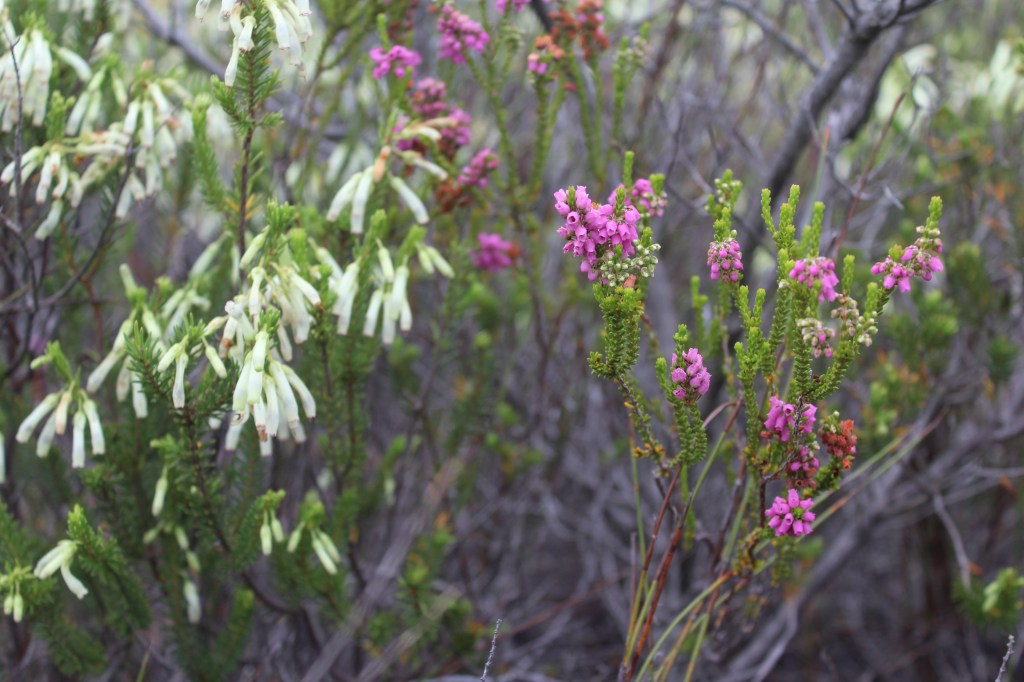
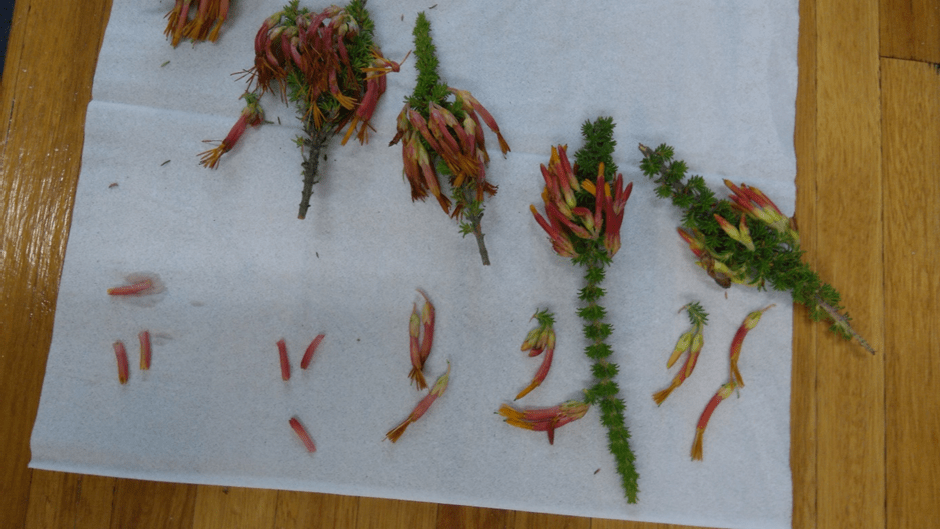
We visited fields of fynbos (a Mediterranean shrubland) during the peak flowering of Erica plants. We could count the number of flowers that were visited by sunbirds and by nectar robbers due to the unique markings that these flower visitors leave on the flowers. Nectar-robbing bees make small holes at the base of flowers to sip nectar. This does not cause pollination in the flowers like when sunbirds probe into the flowers and ruffle up the neat anthers, leaving evidence of their pollination act. We took flowers to our lab and used a spectrophotometer machine to measure flower reflectance, which is the light waves reflected off the corolla surface. This information is combined with knowledge of physiology and processing of colour in birds and bees to model how they perceive the colours. It required a fun treasure hunt across the southern and south-western Cape to find a sufficient diversity of these beautiful flowers. And what wonderful colours we found – pink, purple, red, orange, yellow, green, cream, and white! Everything except blue, which is completely absent in the ericas.
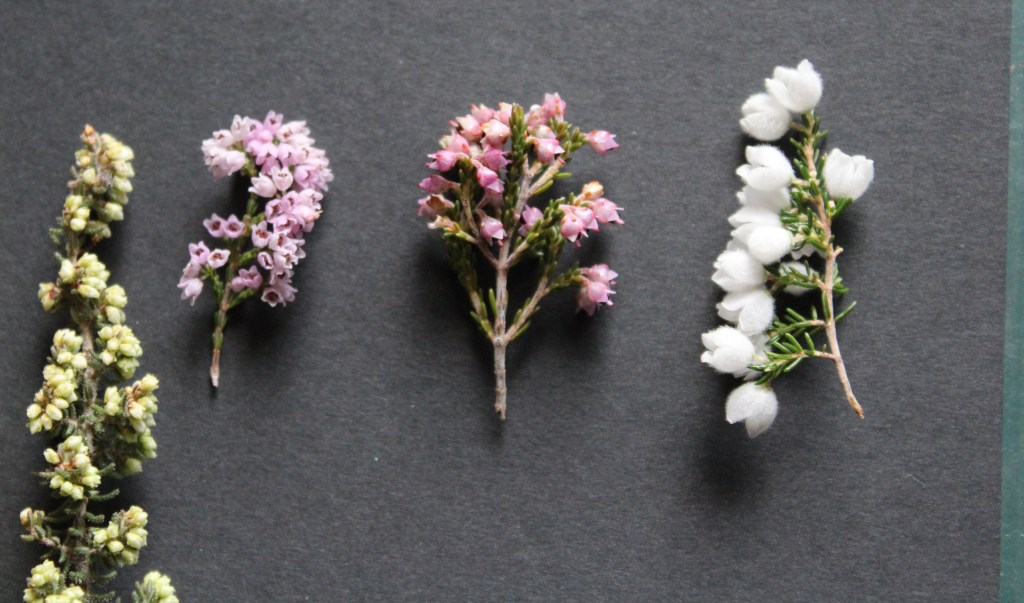
Similar to other studies on hummingbird systems, we find evidence that bird-pollinated flowers are less conspicuous to bees than to birds when we model their vision. Surprisingly, we found that robbing frequency was random relative to flower colour across at 12 natural sites with Erica species of various colours. Why do we not find that less conspicuous flowers are consistently robbed less? Is it due to the specific combinations of colour and mechanical defenses (e.g. flower length and stickiness)? This can best be tested experimentally. Together with a BSc Honours student, we are testing this question with an experiment wherein we manipulate flower colour and other defense traits.
About the authors
Throughout the project my wonderful colleagues and mentors, Prof Colleen Seymour and Prof Claire Spottiswoode, improved the quality of this study with their insightful questioning. As I gathered the data and got stuck into the analyses, I invited Prof Michael Pirie into the collaboration for his systematic expertise and Prof Timo van der Niet for Erica pollination expertise. Their patience and shared enthusiasm were invaluable for this project’s success.
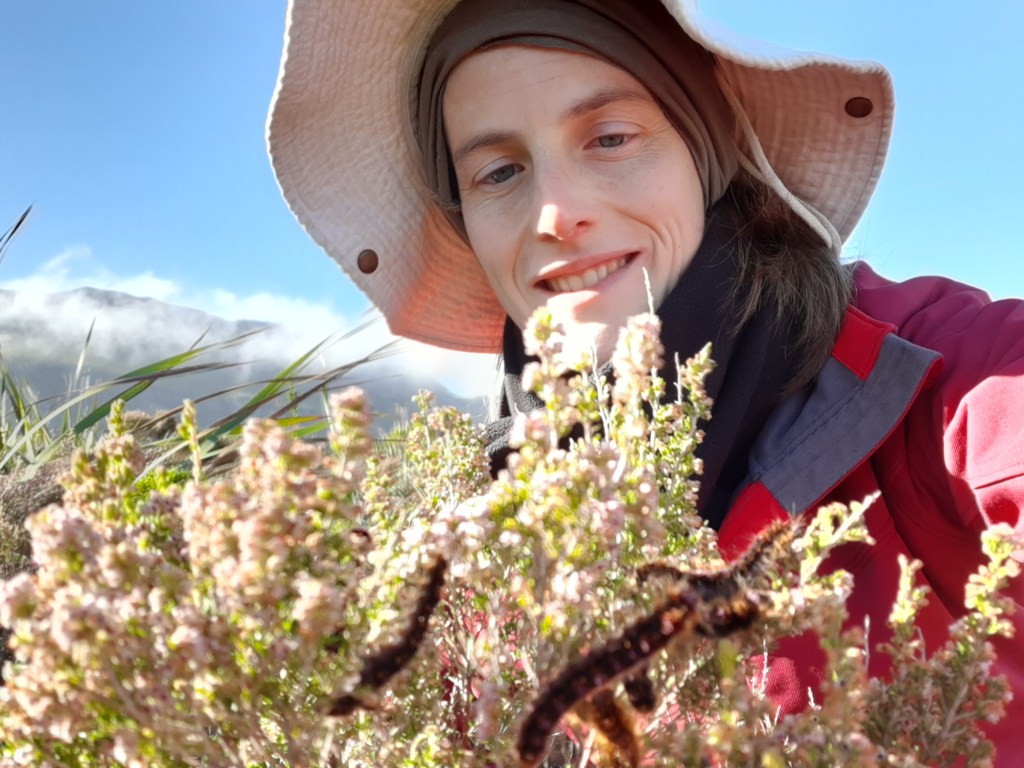
During my studies at Stellenbosch University, I was introduced to fascinating species interactions by our inspiring lecturers and pursued this topic throughout my postgraduate studies. I am privileged to be a lecturer at Nelson Mandela University, George campus, South Africa, where I teach plant studies and conservation while continuing research on plant-animal interactions. The beautiful and diverse fynbos and forests around our campus offer plenty of opportunities for me to further explore the role of visual ecology in plant-animal interactions.
I rarely get to read fiction these days but at the end of this study I managed to finish a science fiction/fantasy novel wherein people’s colour perception determines their social hierarchy – a fun coincidence! As is probably the global pattern, the increasing administrative burden on academics makes it harder to fight for research time and personal time. I wish that I had started sooner in prioritizing the projects that I enjoy.
