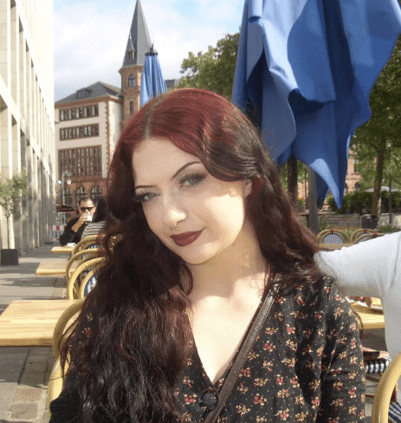
In this ‘Behind the Paper’ blog post, we’re dealing with drought! Author Caitlin Terry – a PhD student at Cornell University – delves into their research article “Forest type and leaf habit mediate thermal and drought tolerance across a tropical elevational gradient“. Caitlin discusses drought and thermal tolerances in tropical tree species, freezing leaf samples in a bedroom transformed into a lab, and their love for maggot reserach!
About the paper
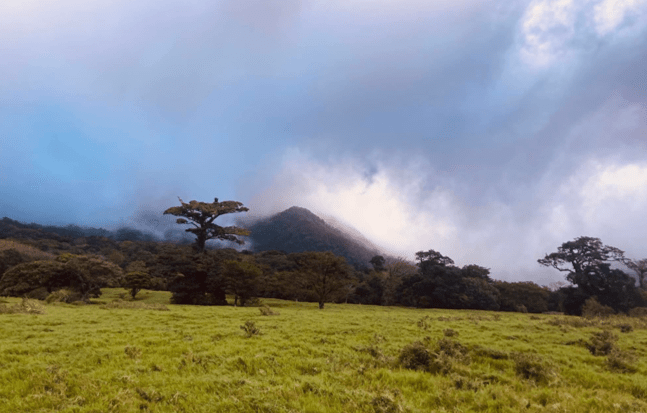
We wanted to understand how drought and thermal tolerances in tropical tree species are influenced by leaf habit (evergreen or deciduous) and differences in local climate. The trees sampled in this study were situated along an elevational gradient in Área de Conservación Guanacaste (ACG), Costa Rica, which spanned from lowland seasonal dry forests to the upland wet forests of Volcán Cacao. Along this gradient, the local climate becomes wetter, cooler, and more climatically stable as elevation increases, making it a particularly useful system for understanding how climatic pressures shape tolerances among species.
My favorite finding from this study was that evergreen and deciduous species exhibited different tolerance patterns: tolerances of evergreen species were to local climate, while tolerances of deciduous species were not. To be more specific, evergreen species at lower elevations (and therefore in drier, hotter, and more variable climatic conditions), had greater leaf-level drought and thermal tolerances than evergreen species in higher elevation sites. Neither of these trends were present for deciduous species, which makes sense when you consider that deciduous species shed their leaves during the dry season in order to withstand drought. This means that the leaves are under less drought- and heat-induced selection pressure than evergreen species, which have to maintain their foliage year-round!
Another interesting outcome was that drought and thermal tolerances were not cor with one another among the 92 species we sampled during the wet season, which suggests that tolerance trait coordination may not be generalizable in tropical forests. This finding is in contrast with a good deal of existing research that provides evidence for coordination among smaller sets of species and under different physiological circumstances.
About the research
In 2024, I was nearing the end of my post-baccalaureate studies in the Biodiversity Research Lab at Virginia Commonwealth University (VCU), and was presented with a compelling opportunity to help develop a field-based research project before heading off to graduate school. My (ever-brilliant and encouraging) advisor, Dr. Catherine Hulshof, came up with the idea to characterize drought and thermal tolerance of tree species across ACG’s diverse forest ecosystems. Following months of experimental design (and figuring out all the quirks of our fancy new equipment), we set out to collect this data in June of 2024. The plan was to collect branches from 33 species in each forest type, and to take measurements of leaf-level drought and thermal tolerance indices using established methods.
We rented a casita on a small fruit farm near Liberia, which we used as a home base for measuring leaf traits. Dr. Hulshof went into the field in the mornings to collect branches, often with the help of ACG taxonomist Adrián Guadamúz. My labmate Perla (Ortiz-Colín) headed the collection of thermal tolerance data, while I focused on collecting drought tolerance data. My job was to prepare leaf samples by punching out tiny discs and freezing them in liquid nitrogen, before taking a measurement with the osmometer that would be used to estimate osmotic potential and turgor loss point.
We made good use of the space that we had. I worked in my room, while the process for collecting thermal tolerance measurements – which involved submerging leaf samples in eleven large water baths at varying temperatures – took over the kitchen, dining area, and other bedroom. Alongside these two major operations, we also had the shared responsibility of taking leaf mass per area and wood density measurements. As you might imagine, collecting such a wide range of traits in such a small space came with plenty of logistical challenges. The spatial constraints were complemented by issues like inclement weather (pouring rain makes collecting branches a difficult task), and finicky equipment – it’s been nearly two years now and I still remember how to clean a VAPRO 5600 thermocouple.
Luckily, none of these issues were fatal. They just made for long days in the bedroom-lab. And on these days I was comforted both by the familiar dramas of Carrie Bradshaw playing out on my laptop screen, and by Guillermo the rooster, who often visited the porch when I would take a step outside for fresh air.
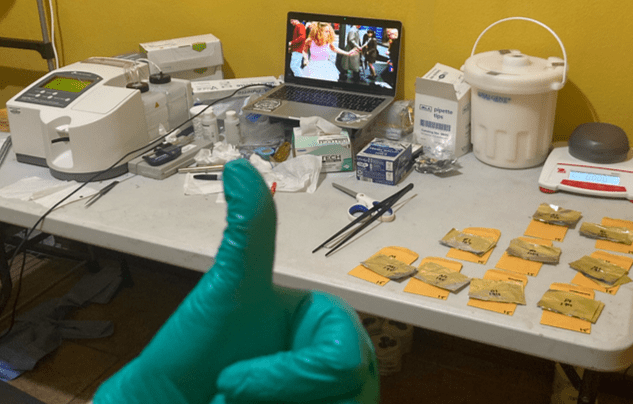
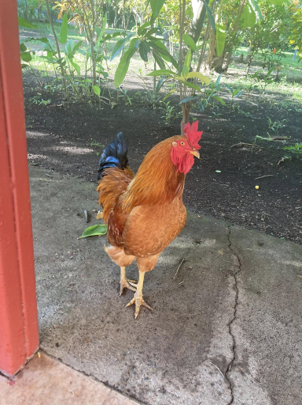
Left: The setup for processing osmometer samples. Right: Guillermo the rooster. (Credit: Caitlin Terry, June 2024)
About the author
My love of ecology was sparked early as an undergraduate when I began working in an insect ecology lab under Dr. Karen Kester, also at VCU, where I helped maintain tobacco hornworm and parasitoid wasp colonies. Slowly learning about the complex interactions between these two species and their environments is what made me realize that I wanted the study of ecology to be a lifelong endeavor. After I graduated, I was lucky enough to engage in post-bacc work that fostered more specific interests in plant-insect interactions and climate change ecology.
I now study the cutest and most ecologically fascinating species in the world (Diptera: Rhagoletis pomonella (Walsh)). Otherwise known as apple maggot, or as the little worm that comes out of cartoon drawings of apples. I’m currently finishing up the second year of my PhD program in Sara Emery’s lab at Cornell University, where I’m trying to understand the current status of the apple and hawthorn races of R. pomonella in New York – specifically, whether hybridization and host switching across races is ongoing, and how climate change is impacting phenology.
When I’m not doing maggot research, I enjoy writing haikus, rollerskating, reading science fiction, doing my makeup, and telling people about my maggot research.