For Americans who came of age in the 1980s and early 1990s, HIV/AIDS was difficult to ignore. Hospitals were filled with young people sick with infections and cancers rarely seen in healthy adults. Friends and partners were quickly dying. Public health officials warned that the disease, primarily transmitted through sexual contact or sharing drug needles, had no effective treatment.
At the height of the U.S. epidemic in 1995, more than 56,000 people with AIDS died in a single year. Then antiretroviral therapy – medications that stop HIV from multiplying – transformed the epidemic. Over the next three years, AIDS diagnoses fell by 45%, while deaths among people with AIDS fell 63%.
Someone who is 20 years old today was born into a very different world. HIV is now a manageable chronic infection for people who can access and remain on treatment. As of 2025, over 20% of people around the world with HIV were unable to access treatment. As an infectious diseases physician caring for people with HIV, I have watched that transformation change not only the lives of my patients, but also the way people think about this once fatal disease.
That success raises an unusual public health question: How do you prevent new infections in a generation that grew up with no memory of a disease at its worst?
HIV is different now
The change in life expectancy with HIV since the 1980s has been extraordinary.
Modern antiretroviral treatment can reduce the amount of HIV in the blood to levels that standard tests cannot detect. People who maintain this viral suppression can live long, healthy lives. Just as importantly, a person with a sustained undetectable viral load won’t sexually transmit HIV – a principle known as undetectable equals untransmittable, or U=U.
People without HIV also now have highly effective prevention options. Pre-exposure prophylaxis, or PrEP, can dramatically reduce the risk of acquiring HIV. Initially available as a daily pill, PrEP has since expanded to longer-lasting options. In 2021, the U.S. Food and Drug Administration approved an injectable drug called cabotegravir that is administered every other month to prevent HIV infection. In 2025, the FDA approved an injectable drug called lenacapavir for HIV prevention, which only requires administration once every six months.
Per-Anders Pettersson/Getty Images
But HIV has not disappeared.
In 2024, 38,793 people were diagnosed with HIV in the U.S. and several territories. People ages 25 to 34 accounted for 37% of those diagnoses – the largest share of any age group.
In 2025, about 26 million of the 41 million people living with HIV around the world were in sub-Saharan Africa. More than 20 million were receiving antiretroviral treatment – an extraordinary expansion of treatment access compared with the early decades of the epidemic.
However, the dismantling of U.S. global aid during the second Trump administration has disrupted the community programs and delivery systems that make sustained HIV treatment possible.
When success makes a disease less visible
Public health sometimes faces a paradox: Successful prevention efforts can make a disease seem less threatening than it still is.
Measles offers a useful, though imperfect, comparison. Before vaccines became available, measles infected millions of Americans and caused hundreds of deaths each year. Vaccination eventually made the disease so uncommon that in 2000, the United States declared measles eliminated in the country.
Yet measles didn’t stop being dangerous. When vaccination rates fall, the virus can return. In 2026, the United States has seen thousands of new measles cases, overwhelmingly among people who were unvaccinated or whose vaccination status was unknown. Declining vaccination rates – fueled in part by persistent misinformation and vaccine skepticism – have allowed measles to regain a foothold. On Nov. 13, 2026, the U.S. lost its measles elimination status.
HIV is very different from measles: It does not spread through respiratory droplets, and there is still no effective HIV vaccine. But the two diseases illustrate a similar challenge: When people no longer regularly witness the consequences of an infection, the reason for preventing it can become less intuitive.
Thanks to medical advances, younger adults view HIV differently from their parents’ generation. The AIDS wards, funeral notices and intense public campaigns of the early epidemic are in history rather than in memory. That generational distance may matter for public health. A 2026 national survey found that only 31% of Gen Z adults said they felt knowledgeable about HIV, compared with 60% of Gen X adults who came of age during the height of the AIDS epidemic.
Accessing HIV prevention tools
It would be too simplistic to say that young people have become complacent only because they no longer fear AIDS. Access to health care, stigma, education and new prevention tools all influence a person’s risk of contracting HIV.
Condoms remain an important HIV prevention tool: When used correctly and consistently, condoms are highly effective at reducing sexual transmission of HIV. But in a study of over 13,500 sexually active U.S. high school students, less than 60% reported in 2013 that they used a condom the last time they had sex. By 2023, that figure declined to 52%. Only 7% of all high school students reported ever having been tested for HIV.
At the same time, the availability of highly effective preventive medication does not mean everyone who could benefit is using it. HIV testing programs funded by the U.S. Centers for Disease Control and Prevention reported that only a little over 57% of people tested in nonhealthcare settings had heard of PrEP. Less than 9% of those with a negative HIV test were currently taking PrEP.
Younger people have also lagged behind older groups in PrEP use. An analysis of a federally run national HIV database found that less than 24% of people ages 13 to 24 who could benefit from PrEP were prescribed it in 2022, compared with over 45% of those ages 35 to 44.
These gaps indicate that having powerful prevention tools is not the same as getting them to the people who need them.
A new message for HIV prevention
HIV in 2026 is not HIV in 1986. Recreating the fear people felt about AIDS in the 1980s is neither realistic nor desirable. Fear came with enormous stigma against gay men, people who inject drugs and people living with HIV – stigma still stubbornly persists today.
Current U.S. HIV prevention campaigns emphasize reducing stigma and often tailor messages to communities disproportionately affected by HIV. But gaps remain in reaching people who do not see themselves as at risk: In 2025, only 34% of sexually active straight adults at increased risk for HIV had heard of PrEP, and just 1% were using it.
Prevention messages for younger generations instead can reflect what decades of scientific advances have made possible: HIV prevention and the ability to live fully with HIV.
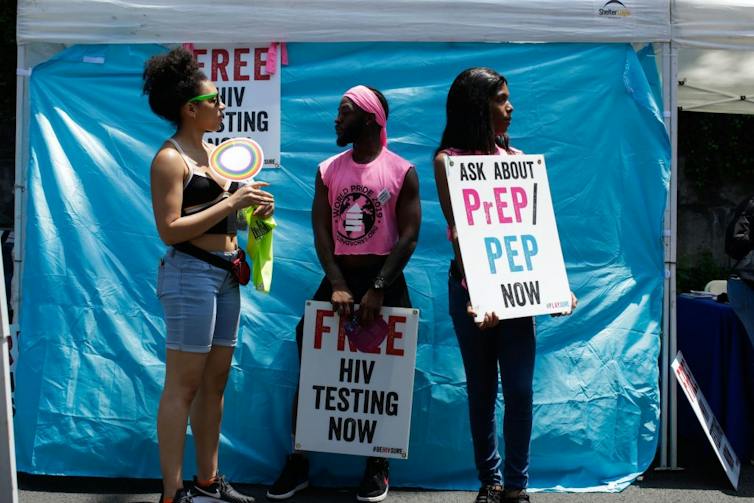
Kena Betancur/AFP via Getty Images
There are still substantial gaps in understanding about HIV treatment and prevention, especially among teens and young adults. Although HIV infection is now treatable and manageable across large swathes of the globe, it still requires regular medical monitoring and treatment. Understanding that effective treatment prevents sexual transmission can fight stigma without suggesting that acquiring HIV has no consequences.
Time travel isn’t necessary to witness some of the devastation that HIV can cause. Access to treatment remains unequal. Some pockets of the U.S. and the poorest regions of the globe still experience AIDS-related complications and opportunistic infections. HIV infection may also lead to a slightly lower life expectancy due to an increased risk of cancer or cardiovascular disease.
World AIDS Day on Dec. 1 is partly an opportunity to remember the millions of people lost during an epidemic that transformed medicine, public health and entire communities. Preserving that history is not about asking today’s young people to inherit an earlier generation’s fear. The greater challenge is making sure they inherit its lessons – while giving them the far better tools for prevention that earlier generations never had.