
In this behind the paper blog post, author He Wanci – a PhD student at the State Key Laboratory for Vegetation Structure, Functions and Construction, Yunnan University, China – discusses the article “Elevated nitrogen deposition protects an invasive plant from herbivory through altering leaf volatile-mediated tritrophic interactions“, which was recently published in Functional Ecology. He Wanci discusses the impact of atmospheric nitrogen on volatile communication, the need for patience when conducting odour experiments, and encountering ecological phenomena when travelling!
About the paper
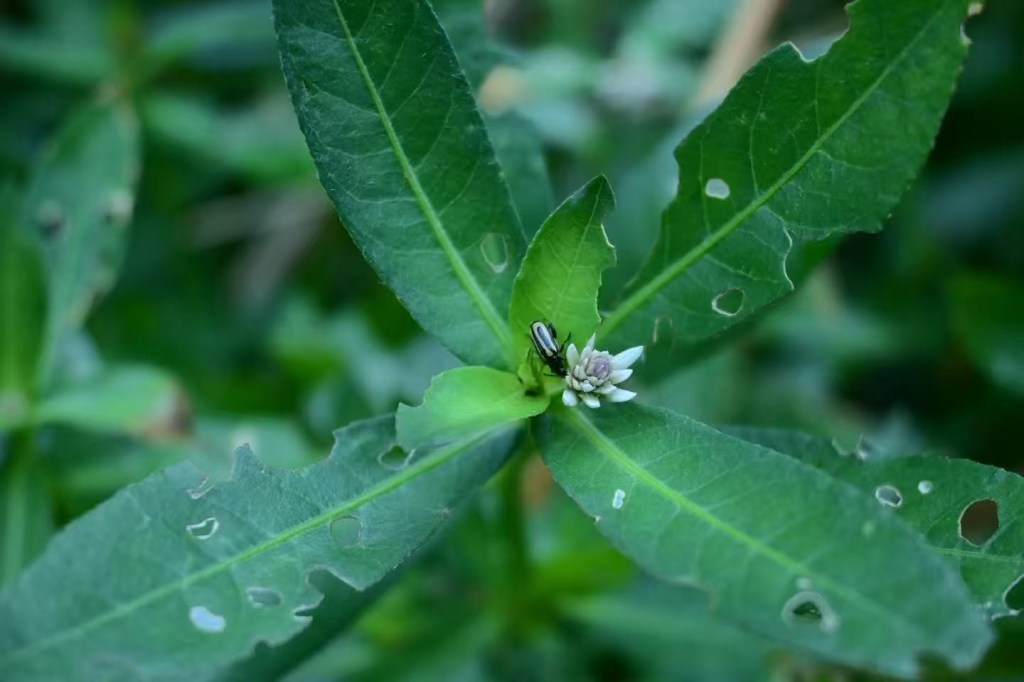
Plants cannot run from their enemies, but they are far from silent. The volatile compounds released from leaves carry information that herbivores and their natural enemies can use to find food, hosts or prey. We asked whether atmospheric nitrogen deposition could alter this chemical conversation in a way that favours an invasive plant.
We compared Alternanthera philoxeroides, a South American species that is invasive in China, with Alternanthera sessilis, its native congener. Because the two plants often grow together and are similar in appearance, they offered a useful system for asking how an invader and a native species respond to the same environmental change.
Our field surveys covered five locations along a broad latitudinal gradient in China. At sites with higher nitrogen deposition, A. philoxeroides had less leaf damage and fewer herbivore eggs than A. sessilis. We then recreated nitrogen deposition under controlled conditions. Added nitrogen sent the two plants in opposite chemical directions: A. philoxeroides released more volatiles from both intact and herbivore-damaged leaves, whereas A. sessilis released fewer.
The insects responded to those changes. A specialist flea beetle and a generalist insect were less attracted to nitrogen-treated A. philoxeroides and laid fewer eggs on it. By contrast, the predatory ladybird beetle Harmonia axyridis was strongly attracted to its herbivore-induced odour. Methyl salicylate emerged as a key part of the signal: it repelled both herbivores but attracted the predator.
The take-home message is that nitrogen enrichment can change more than plant growth. In our study system, it reorganised communication across three trophic levels, giving the invader a potential double advantage: fewer herbivores arrived, while more predators followed the scent of attacked leaves. This mechanism may help explain why some invasive plants perform especially well in nitrogen-rich environments. It also raises a practical concern because the specialist flea beetle is used to control A. philoxeroides; if nitrogen weakens its attraction to the target plant, biological control may become less effective.
About the research
We combined field observations with controlled experiments because each approach answered a different part of the question. The field survey showed that the pattern occurred under real environmental conditions. The laboratory work allowed us to isolate nitrogen and follow the chain from plant chemistry to insect behaviour.
We collected both plant species from five populations, grew 120 clonal plants for eight weeks, and applied either a control treatment or a weekly dose that simulated nitrogen deposition during the growing season. We then asked insects to choose between odour sources in Y-shaped and four-arm olfactometers. We also recorded where female herbivores laid their eggs.
To test the next trophic level, we allowed larvae of the generalist insect Spodoptera litura to feed on the plants for 24 hours. After removing the larvae, we tested whether the predatory ladybird followed the odours released by the damaged plants. At the same time, we trapped the volatile compounds and identified them using gas chromatography-mass spectrometry.
Odour experiments reward patience. We standardised leaf area and airflow, rotated the arms of each olfactometer, cleaned the apparatus between trials and used every insect only once. These details were essential: a preferred position or a trace of the previous odour could otherwise look like a biological preference.
The most surprising result was that A. philoxeroides did not appear to face the usual choice between growth and defence. Nitrogen improved its growth while also increasing its volatile emissions. The native species showed the more familiar pattern, with stronger growth accompanied by weaker volatile signals.
Our next step is to test whether this pattern holds beyond one invasive-native species pair. Comparisons between native- and introduced-range populations, additional herbivores and natural enemies, and long-term field experiments would show how general and persistent the advantage is. We also need to account for atmospheric chemistry. Roadside pollutants such as nitrogen oxides and ozone can break down plant volatiles after they are released, so future reaction-chamber and field studies should measure both nitrogen deposition and the lifetime of the odour signal.
About the author
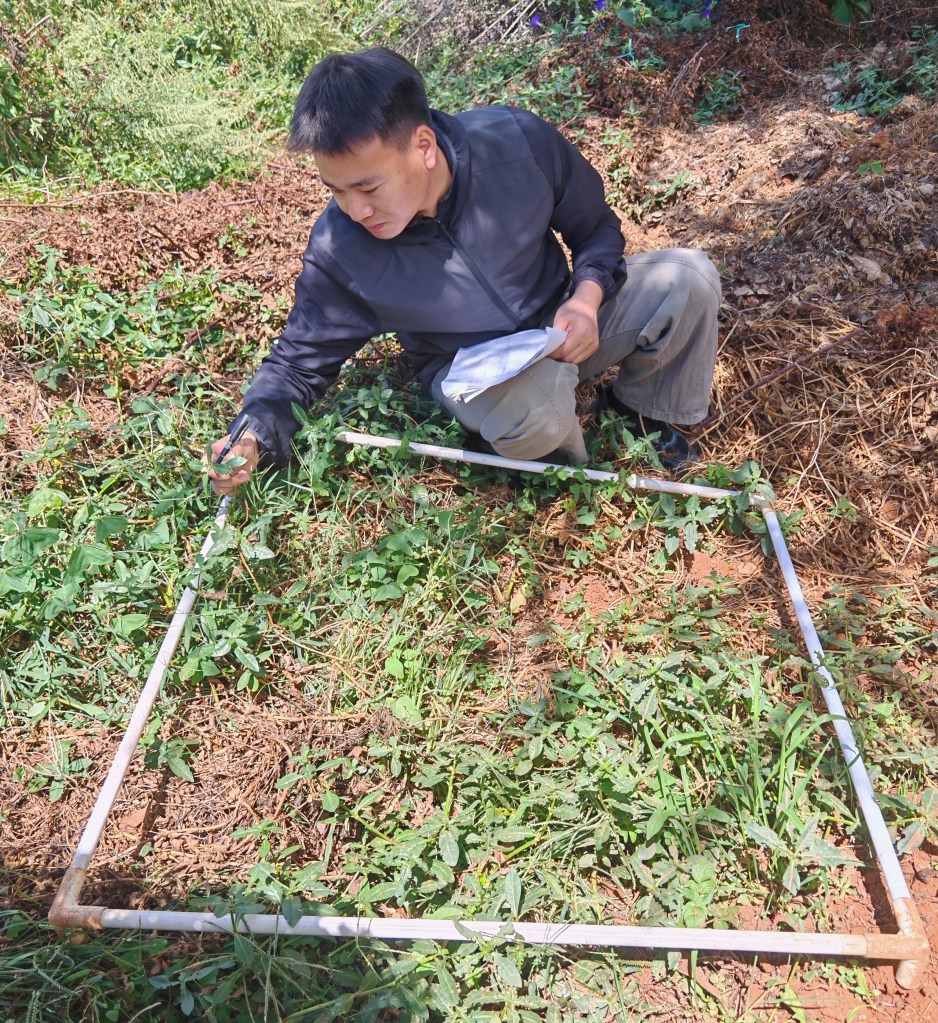
I am He Wanci, the first author of this article. I am currently a PhD student at the State Key Laboratory for Vegetation Structure, Functions and Construction, Yunnan University, China. The corresponding author, Tiantian Lin, is my supervisor. My research lies at the intersection of plant ecology, invasion ecology, and chemical ecology. I am particularly interested in how environmental changes alter the signals exchanged between plants, herbivores, and their natural enemies. This project combines these interests by tracking an environmentally driven factor from the field to plant chemistry and then to insect behavior. Outside of research, my favorite activity is traveling. During my travels, I often discover many interesting ecological phenomena, which add many intriguing experimental ideas and designs to my research. So, my younger self should definitely get out more and see this beautiful world!