
Archaeological analysis of two mosaic floor fragments discovered in Berat, Albania, has identified them as remnants of early Christian basilicas dating to Late Antiquity.
The finds provide rare material evidence for the urban and religious landscape of the ancient city of Antipatrea, a settlement whose early history remains poorly documented due to limited archaeological investigation.
Berat, a UNESCO World Heritage Site in central Albania, is widely known for its well-preserved Ottoman urban architecture from the eighteenth and nineteenth centuries. However, the archaeological record indicates that the area has been continuously inhabited since at least the fourth or third millennium BC. By the seventh or sixth century BC, an urban settlement surrounded by defensive walls had developed at the site.
Ancient historical references to Antipatrea are sparse. The Roman historian Livy records that the city was destroyed in 200 BC during the Second Macedonian War, when Roman forces led by the consul Publius Sulpicius Galba burned the settlement and dismantled its fortifications.
The city reappears in historical sources in the fifth century AD, when the Eastern Roman emperor Theodosius II is said to have rebuilt its walls and renamed it Pulcheriopolis in honour of his sister Pulchera. During the Byzantine period, the city became an episcopal seat, and Emperor Justinian I constructed a hilltop fortress that would later form the basis of the medieval castle that dominates the site today.
Despite this long historical trajectory, archaeological data from ancient Antipatrea remain extremely limited. The modern city’s historic centre has never been subject to systematic excavation. The only significant investigations took place between 1973 and 1975, when excavations in the castle area uncovered Late Antique ceramics and imported pottery near the fortress gate, followed by a smaller campaign in 1987.
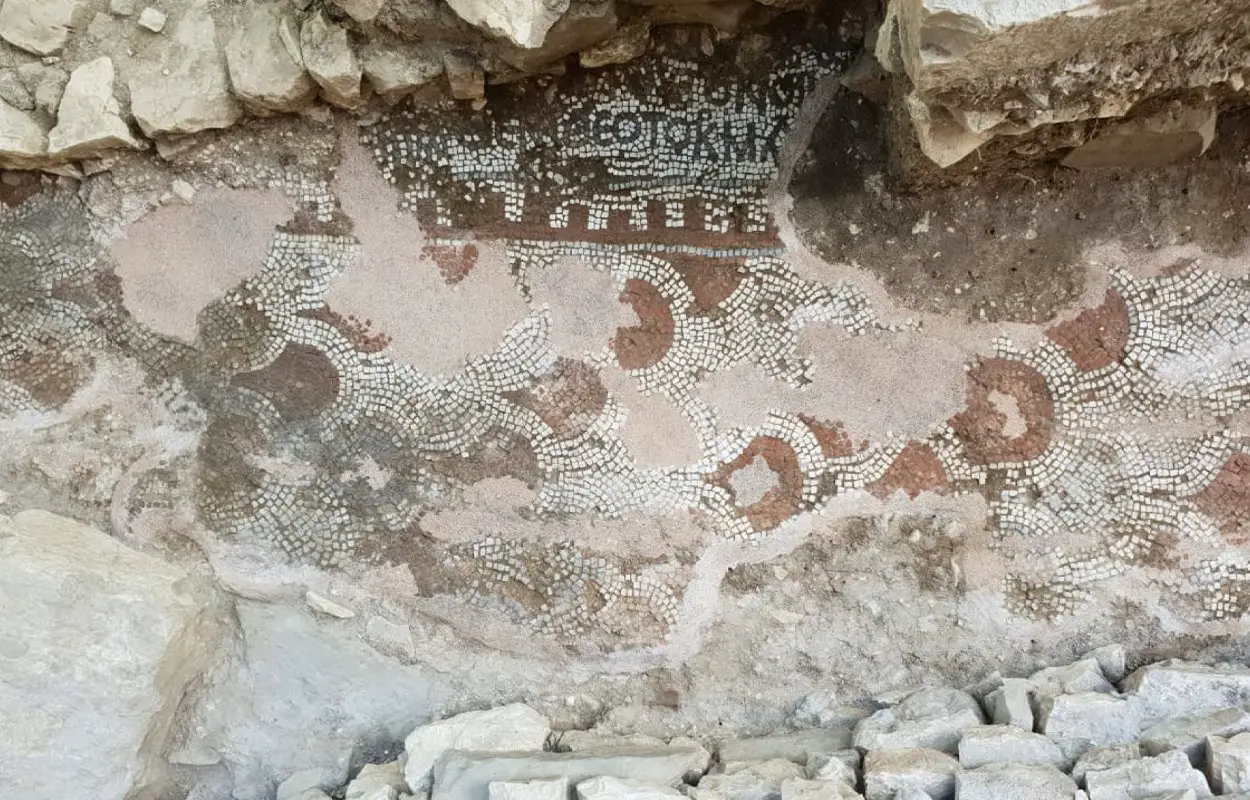
The first mosaic floor fragment was uncovered in 2012 during infrastructure work installing a new water hydrant network within the castle complex. The surviving section measures approximately 6 by 3 metres and is composed of polychrome tesserae arranged in geometric patterns using white, red, pink, violet, grey and black stone. A layer of burning across the surface indicates the destruction of the associated structure, likely an early Christian basilica. A partially preserved Greek inscription embedded within the design is interpreted as a dedication, possibly recording the patrons who financed the church’s construction.
A second mosaic fragment was discovered in 2018 during drainage works beneath the foundations of the King’s Mosque in the lower city. This smaller section, measuring roughly 2.3 by 0.8 metres, was created using the opus tessellatum technique and also bears traces of burning. A fragmentary Greek inscription includes the word Theotokos (“Mother of God”), a title that gained doctrinal prominence following the Council of Ephesus in AD 431.
The inscription provides an important chronological indicator, suggesting the mosaic was produced after the mid-fifth century. Additional archaeological evidence, including coins found in overlying layers dating to the reign of Emperor Justinian II, supports a date in the late fifth or early sixth century AD.
Stylistic analysis indicates that the mosaics share decorative elements common to Late Antique mosaic traditions across the Balkans and Mediterranean, including intersecting octagons, guilloche borders and interlaced geometric bands. However, the materials used—local limestone and terracotta—suggest production by regional workshops. Comparable motifs have been identified at nearby archaeological sites such as Bylis and Butrint, indicating the existence of a network of craftsmen working across the region.
The findings also provide new context for the Codex Beratinus Purpureus, a sixth-century illuminated Gospel manuscript written in silver ink on purple parchment and preserved in Berat since at least the fourteenth century. Scholars have long debated whether the manuscript originated locally or arrived later. The evidence for multiple early churches in Antipatrea strengthens the possibility that the manuscript was produced within the city’s own ecclesiastical environment.
Sources : KOHA
