In this ‘Behind the Paper’ blog post, author Upama Aich – a Forrest Research Fellow at the University of Western Australia – discusses her paper “Developmental environment and age shape macronutrient allocation to eggs and ejaculates“, which was published in Functional Ecology in February 2026. Upama shares how fluctuating salinity can leave lasting reproductive signatures in mosquitofish, the challenges of conducting biochemical assays with tiny sample volumes, and how birding and butterflying during her undergrad sparked her interest in ecology.
About the paper
Environmental stress is rarely constant in nature. Temperature, salinity, and other stressors often fluctuate, forcing animals to repeatedly adjust their physiology. In our study, we tested whether fluctuating stress during early-life development affects reproductive investment differentially than a stable stress of the same average intensity.
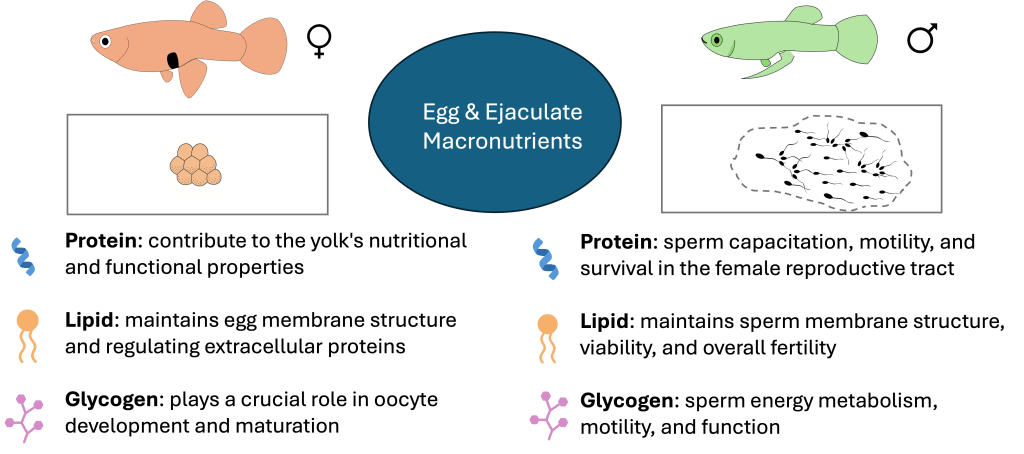
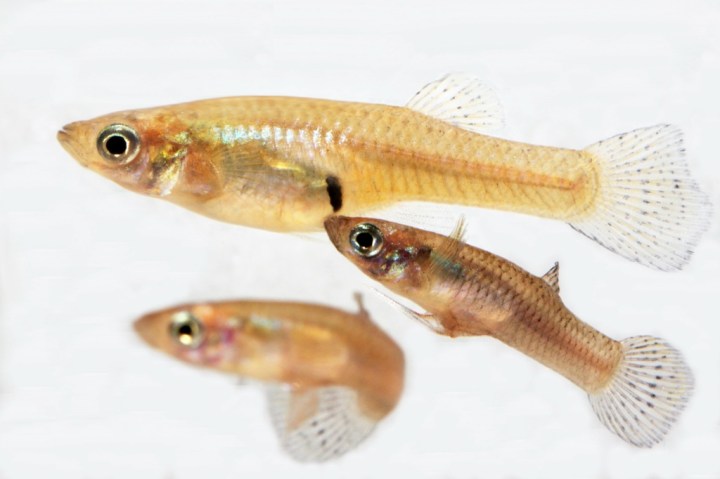
More specifically, we asked whether the pattern of salinity exposure (stable vs fluctuating) shapes the macronutrient allocation of reproductive investment. We used eastern mosquitofish (Gambusia holbrooki), a small livebearing freshwater fish. In this species, reproductive success depends on both female provisioning to eggs and intense post-copulatory competition among males. Instead of measuring reproduction as behaviour or fecundity, we asked a more mechanistic question: what happens to the gamete macronutrients that actually fuel reproduction (protein, lipid, and glycogen) in female eggs and male ejaculates (sperm, and seminal fluid)?
Our take-home message is simple: fluctuating stress can be more influential than stable stress of salinity, and its effects depend on sex and age. Females that developed under fluctuating salinity produced eggs with lower protein content, while egg lipids and glycogen were largely unchanged. Males showed an age-dependent shift: older males that developed under fluctuating salinity produced ejaculates with higher glycogen content than other groups. Males from both the stable and fluctuating salinity environments also had lower lipid content than those from the freshwater control. Together, these results show that fluctuation in an environmental stressor can leave lasting reproductive signatures that differ between sexes and at different life stages.
Why does this matter beyond mosquitofish? Studies on environmental changes often focus on shifts in average conditions, but ecological reality is often about variation, for example, frequent spikes, swings, and unpredictable transitions. Our results suggest that fluctuations can alter reproductive allocation in ways that constant stress does not, and that these effects can differ between females and males. This matters because egg provisioning and ejaculate composition are fundamental to fertilisation and early development across taxa, so understanding how environmental fluctuation reshapes these investments can improve predictions of how populations respond to increasingly changing environments.
About the research
We used a split-brood design: newborn siblings from the same mother were randomly distributed across three developmental environments: a freshwater control, a stable saline stress (constant 10‰), or a fluctuating saline stress (cycling 0-20‰ with the same mean, 10‰). This design is powerful because it reduces genetic and maternal confounds when comparing treatments. After fish reached sexual maturity, we measured fish investment in reproductive macronutrients in both sexes. That is, protein, lipid, and glycogen content of female eggs (measured once at maturity because repeated non-lethal egg sampling isn’t feasible in this livebearer), and the same macronutrient content of male ejaculates (sperm + seminal fluid) at two ages, young and old, after an extended mating period, to test whether the developmental environment alters patterns of reproductive ageing.
One of the issues was working with biochemical assays on small amount of ejaculates that presented practical challenges, particularly tiny sample volumes and the need for high dilutions. To ensure reliable data, we had an expert Dr Asif Ahmed in our group who followed established protocols, used consistent sample handling and standard curves, and validated technical precision with replicate measurements. These steps were ensuring to understand that patterns reflected biological signal rather than measurement artefacts.
Two things stood out in our results. First, egg protein responded strongly to fluctuating salinity, but egg lipids and glycogen did not. That pattern hints that fluctuating stress may disproportionately disrupt pathways tied to protein provisioning (for example, via endocrine sensitivity of vitellogenesis), while females may preserve certain energy stores (e.g., lipids and glycogen) under stress while protein provisioning is more constrained.
Second, we expected stress to generally suppress male investment, but we found a striking age-by-history pattern: older males from fluctuating salinity produced ejaculates with particularly high glycogen content, hinting at context-dependent late-life allocation strategies. This is consistent with the idea that late-life reproductive decisions can be strategic, especially when ageing and prior stress push individuals toward terminal reproductive investment, that is, making the most of current opportunities when future reproduction is uncertain.
The next step would be to connect macronutrient allocation to functional outcomes. For example: do changes in egg protein translate into differences in offspring growth or survival? Or, do shifts in ejaculate glycogen translate into measurable differences in sperm performance or competitive fertilisation success? Our study identifies the physiological changes; future work can test how those changes play out under realistic mating and environmental scenarios, especially under the kinds of fluctuating regimes predicted to become more common in the future.
About the author
I am an early-career behavioural and evolutionary biologist. As a Forrest Research Fellow, I am currently based at the University of Western Australia. I grew up in a densely populated city, so unlike many of my peers, I developed passion for ecology quite late in my career. I used to go birding and butterflying during my undergrad, and started appreciating the role and value of nature more closely since then. My current research obsession is understanding how environmental change, especially human-driven stressors, affects animal behaviour, life-history trade-offs, and reproduction.
Outside of research, I love getting outdoors, especially for a bushwalking (as we call it here in Australia). I allocate most of my weekend mornings for a walk through Kings Park in Perth. My campus also sits alongside the Swan River, and I’ve been making a more intentional habit of taking my lunch break by the water, where you can sometimes even spot dolphins.
Being in academia is my dream turned into reality and love that I get to ask research questions for work and get paid to answer them through experiments. But like many early-career researchers, I feel the challenges and uncertainties of securing a stable position and research fundings in academia is pretty intense. A lot of my questions need controlled lab experiments, which means I’m always on the lookout for chasing funding to keep the lab supplies going which can take some fun out of doing the actual science. What helps is finding experienced collaborators and mentors who care about rigour and people, and building a research community that makes space for both.
If I could give my younger, and even current self one piece of advice, it would be: take it easy. We live in a world that is designed to be overwhelming and fast-paced. Everyone is hustling and we, including me, need to slow down and touch the grass more often.