
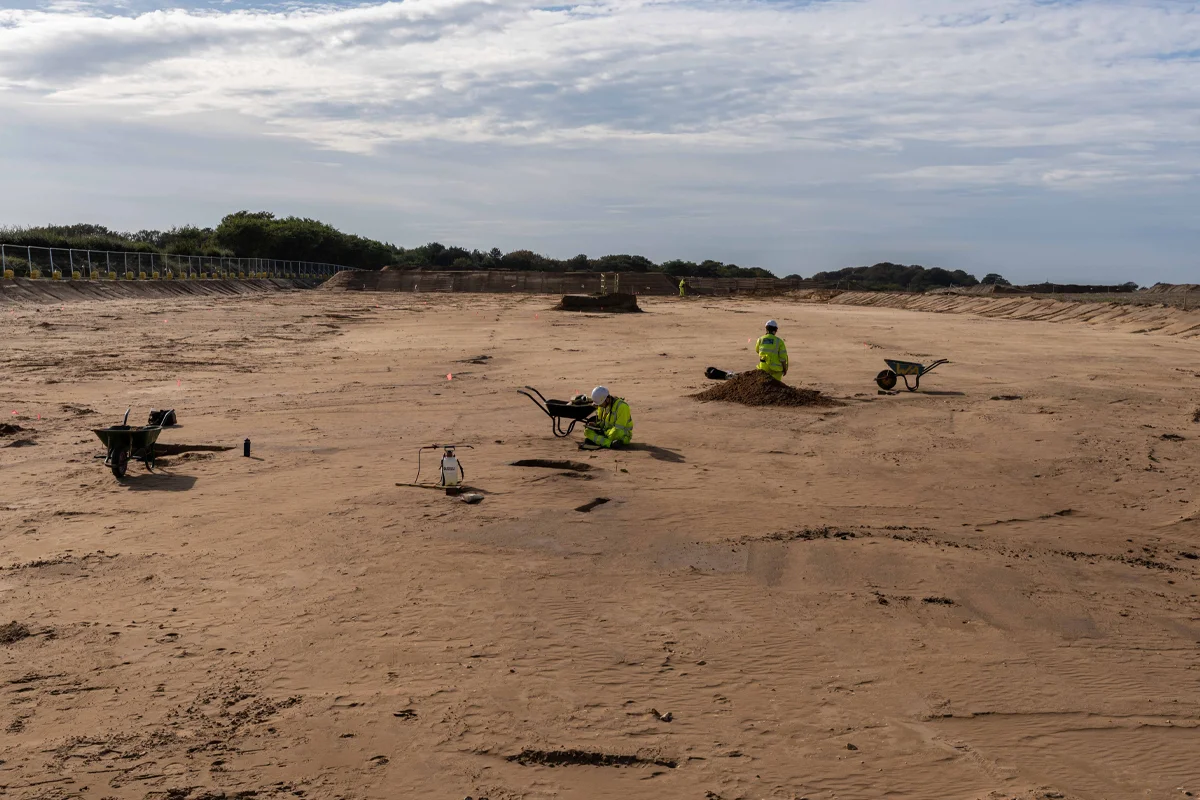
MOLA and Wessex Archaeology have been conducting a large-scale excavation ahead of the East Anglia TWO and ONE North projects on behalf of ScottishPower Renewables.
To date, the excavation in Suffolk, England, has exposed over 24 hectares (53 acres), revealing an ancient landscape containing a previously unknown Anglo-Saxon settlement alongside artefacts spanning thousands of years.
The settlement consists of several large wooden longhouses, evidenced by rows of post holes and a central hearth that served as both a cooking area and to heat the internal areas of the structure.
According to experts, the longhouses date from between the 5th and 11th centuries AD, while occupation of the village endured until the 1300s during the Late Middle Ages.
It was during this late period that a series of famines and plagues, including the Great Famine of 1315–1317 and the Black Death, massively reduced medieval populations and led to the abandonment of many villages and settlements.
In the wider excavation area, archaeologists uncovered finely crafted prehistoric tools, including a polished axe head and flint arrowhead dating back 4,000 to 6,000 years.
The arrowhead, complete and unbroken, is a particularly rare discovery given its fragile form. Evidence of Stone Age toolmaking suggests the landscape supported early hunters and craftspeople long before the medieval village emerged.
On the East Anglian coast near Sizewell, archaeologists also uncovered evidence for much later local industry in the form of medieval kilns, likely used to produce pottery, ceramics, or lime.
Matthew Ginnever, Senior Project Manager at MOLA-Wessex Archaeology, said: “The archaeological programme is already proving there is much to uncover about the history of East Anglia and its past populations.
These sites were always rural, but they were by no means isolated. We’ve discovered pottery associated with the ‘Beaker folk’, who lived across Europe in the early Bronze Age and brought new cultures and ideas to Britain. This suggests locals were in contact and trading with groups on the continent more than 3000 years ago.
We look forward to adding more details like this to the rich tapestry of East Anglia’s heritage as our work on the project continues.”
Header Image Credit : MOLA-Wessex Archaeology
Sources : MOLA