
A remarkable hoard of Iron Age metalwork dating back approximately 2,000 years has been uncovered in West Norfolk, shedding new light on the ceremonial and martial traditions of Britain’s Celtic communities.
The discovery was made during a routine archaeological excavation conducted by Pre-Construct Archaeology, as part of the standard planning process preceding residential development.
What initially appeared to be a dense block of soil soon revealed itself to be one of the most significant Iron Age finds in Europe in recent decades.
At the heart of the assemblage is a near-complete bronze carnyx – a battle trumpet distinguished by its dramatic animal-head design – along with fragments from a second example.
Carnyces were used by Iron Age warriors across Europe to intimidate enemies and rally troops, and were frequently depicted by Roman writers and artists as exotic war trophies. Only three examples are currently known from Britain, and the Norfolk specimen is among the most complete ever found.
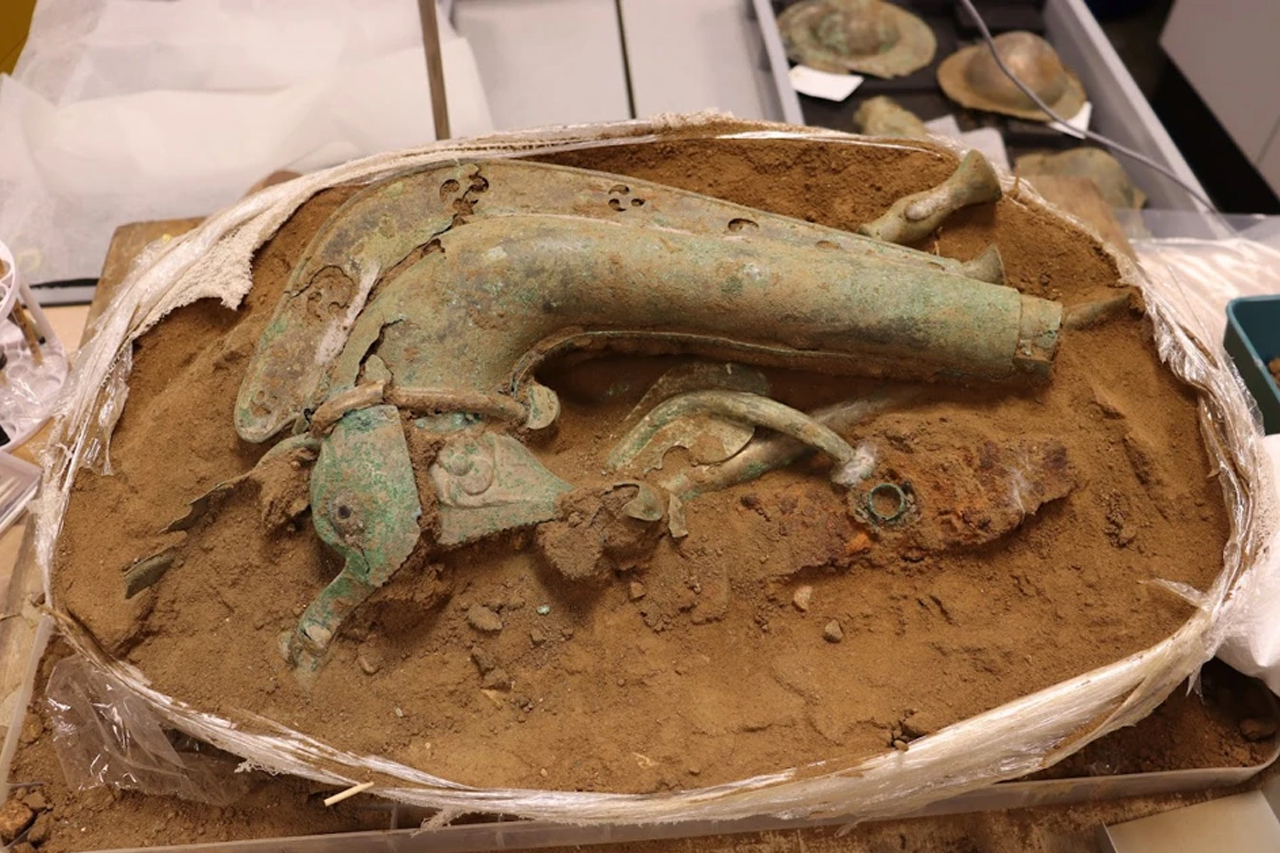
Also included in the hoard is a sheet-bronze boar’s head, believed to have once adorned a military standard, symbolising strength and ferocity in Celtic culture. Five shield bosses and an iron object of uncertain function complete the group, making the hoard exceptional not only in a British context but also when compared with finds across Europe.
Given the extreme fragility of the objects, the entire assemblage was carefully lifted from the ground while encased within a solid block of soil. Senior conservator Jonathan Clark of Norfolk Museums Service is leading the painstaking micro-excavation, a process that involves removing soil millimetre by millimetre, stabilising the metalwork, and documenting every stage to ensure that no archaeological evidence is lost.
“The condition of the carnyx and associated objects is extraordinarily delicate,” Mr Clark said. “Each element must be secured and recorded before it can be safely separated from the surrounding soil.”
Conservation specialists at Norfolk Museums Service are now conducting preliminary examinations, though extensive stabilisation will be required before detailed academic research can proceed. Historic England is coordinating the project in partnership with Pre-Construct Archaeology, Norfolk Museums Service and the National Museum of Scotland, bringing together expertise from across the UK.
The discovery will be featured in the forthcoming series of the BBC programme Digging for Britain, which airs from 7 January 2026, offering viewers a first glimpse of a hoard that is already being hailed as one of the most important Iron Age finds of the century.
Header Image Credit : Norfolk Museums Service
Sources : Historic England