
Archaeologists have uncovered a rare mosaic room in the ancient city of Smyrna, featuring a central “Solomon’s Knot” motif believed to have served as a protective symbol against evil and misfortune during Late Antiquity.
The discovery was made along the Agora North Street during year-round excavations conducted under the Turkish Ministry of Culture and Tourism’s “Heritage for the Future” project. The initiative aims to safeguard and promote key archaeological sites across Türkiye, many of which lie beneath today’s densely built urban areas.
The newly exposed mosaic floor measures approximately three by four metres and is composed of interlocking twelve-sided geometric panels, a decorative style widely used in the Late Roman period.
At the centre lies the Solomon’s Knot, formed by intertwined loops that have appeared across multiple cultures and historical eras. Archaeologists interpret the symbol as an apotropaic device intended to ward off harmful forces, envy, and the so-called “evil eye.”
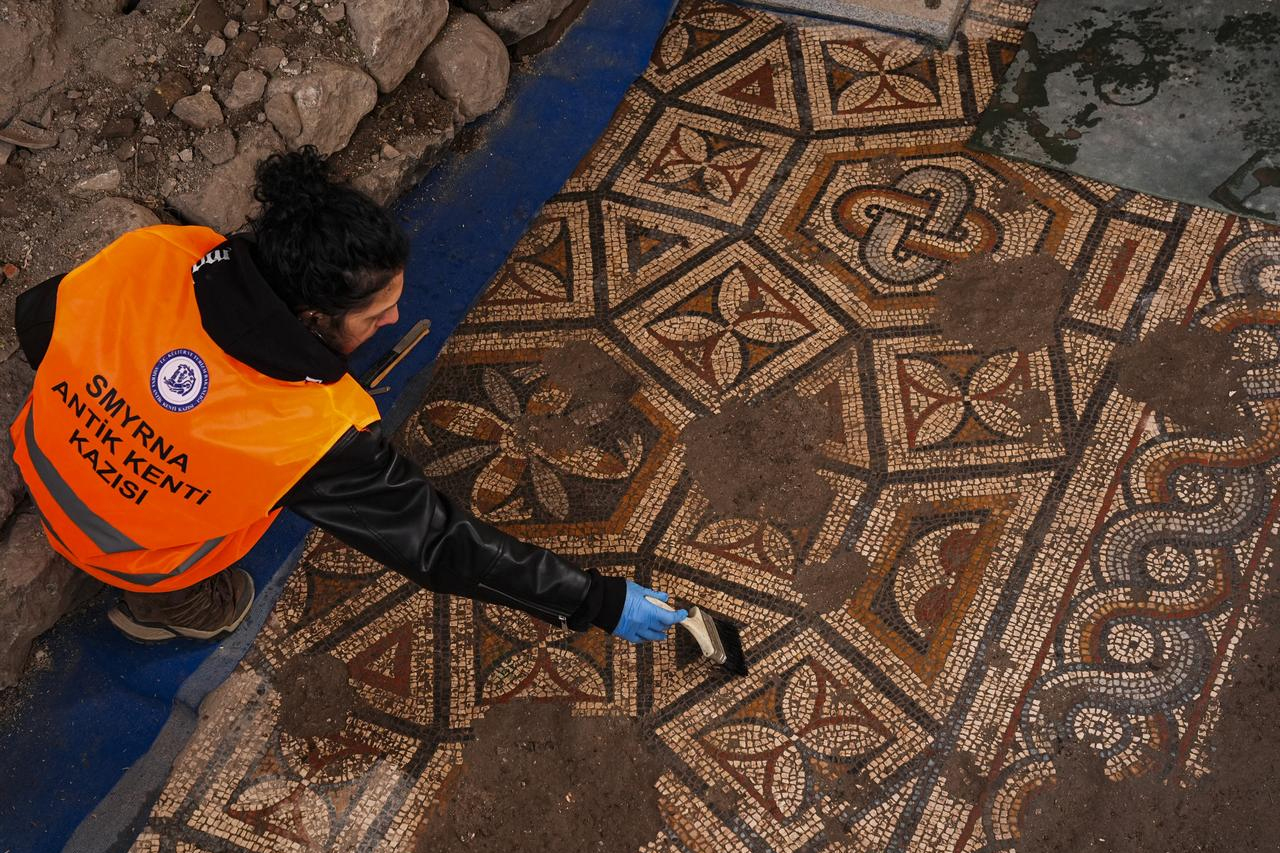
Current research concentrates on the agora and the ancient theatre, two pillars of civic life in the classical world. The newly found mosaic belongs to a building dated between the fourth and sixth centuries AD, though it remains unclear whether the structure functioned as a private residence or a semi-public space.
In addition to plant-based motifs and geometric ornaments, small cross figures surround the central knot. While such crosses later became associated with monotheistic traditions, the combination of elements reflects a layered belief system in which earlier symbolic meanings were preserved alongside emerging religious iconography.
One of the most striking aspects of the site is evidence that the room was reused in the nineteenth century. Structures associated with a non-Muslim hospital or nearby residences were built directly over the ancient floor, with traces of wall plaster applied on top of the mosaic. This indicates that the design was rediscovered, appreciated, and incorporated into later buildings, extending its visible life by nearly 1,500 years.
Excavations are set to expand in 2026, and archaeologists believe further rooms or related structures may soon emerge, offering new insight into everyday life in Late Antique Smyrna.
Header Image Credit : AA
Sources : Turkiye