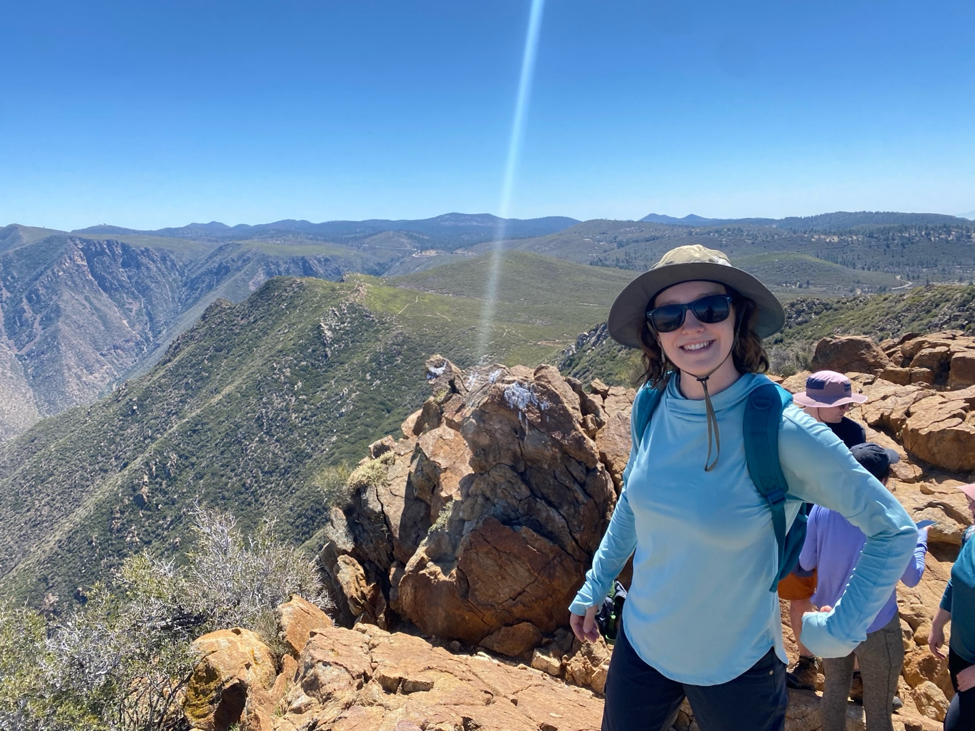
In this Behind the Paper blog post, author Julia Bebout – a PhD student at UC San Diego – delves into the article “Trait responses to competition are mostly parallel among competitor plants but can cause convergence or divergence in key traits”, which was recently published in Functional Ecology! Julia shares how competing annual plants shift traits in parallel, dealing with rattlesnakes, feral honeybees and rain in the field, and the excitement of the first paper to come out of her PhD!
About the paper
We know that plants grow with different traits (like height or leaf nitrogen content) when they experience competition than when they grow alone. In our paper, we tested whether plants experiencing competition shifted their traits in ways that made them more similar to or more different from their competitors. This question interested us because the impact of competitors on the fitness of their neighbors can depend on how similar or different the competing species’ traits are. Ultimately, we found that most plant traits shifted in parallel for competing plants, neither making traits more similar nor more different. Our study also showed that trait shifts in response to competition depended more on the competitor species than the focal species, meaning that within a given competitive neighborhood, the various species of native and invasive California annuals we studied showed similar trait shifts. These results are interesting to us because they might mean that only very specific trait shifts in response to competition impact the strength of competition between species for resources, at least in the California grasslands we studied. Our findings may support the trait hierarchy hypothesis, meaning that for multiple species in a given competitive environment, there was one best functional strategy, rather than multiple diverging effective strategies.

About the research
We conducted our field experiment at the University of California San Diego Biology Field Station in La Jolla, California. We planted one individual of each of six species into lawns of one of the six species. We varied how dense the competitor lawn was, resulting in a gradient from very low to very high competition. Then we measured the traits and biomass of the six individuals in each plot experiencing this competition to see how their traits changed as competition intensified. Some of the biggest challenges we faced were rattlesnakes and feral honeybee colonies, but we also had a particularly rainy growing season, which meant we had a lot of weeding to do. Luckily, our experiment was designed with spatial randomization so that any consistent differences between plots were due to the species and density of the competitor lawn. Plus, we imposed our competition treatments on a constant abiotic background, so we weren’t trying to manipulate rainfall with shelters or irrigation which might have been overshadowed by the wet season.
We did find our results surprising. There’s prior work showing that plasticity can make traits more similar or more different between competitors, but we had expected that competition for water might allow plants to differentiate into multiple drought resistance strategies. Instead, we had a very rainy growing season, and we think the plants had to compete particularly intensely for light. The next step for research on this topic might be to test conditions which drive plastic trait divergence versus convergence among competitors. Perhaps if water were more limiting, we would have seen more diverging strategies among species. Plasticity might play a different role in our study system in a wet year versus a dry year.
About the authors
I first became fascinated by ecology in high school while taking a hike with a forest ecologist at a program run by the nonprofit, Wildlife Leadership Academy. He opened my eyes to the complex interactions among the plants surrounding us, and since then, I’ve felt endlessly curious about the hidden relationships of the plants I see while spending time outside. Then, as an undergrad, I got involved in ecology research working with Dr. Robert Booth on the fire and vegetation history of a lagoon in the Apostle Islands via soil cores with fossil charcoal and pollen. That experience showed me how data and statistics could tell us about ecology, even the distant past. How amazing! Currently, I’m a 4th year PhD student at UC San Diego working with Dr. Elsa Cleland studying the role of phenotypic plasticity in California grassland communities. This is the first paper to come out of my PhD work, so I’m really excited about it. My most recent ecological obsessions are hemiparasitic plants and their interactions with native and invasive species. Outside of research, I love teaching, singing, cooking for my friends, and rock climbing.