
Can hummingbirds eat more than half their body weight per hour? In this week’s blog post, author Rosalee Elting answers that question for us! Based on their recent paper: “Foraging plasticity and physiological adaptations enable hummingbirds to subsist on dilute nectars”, Rosalee shares some of the fascinating results regarding energy expenditure in hungry hummingbirds. Outside of her captivating love for our little energy filled birds, Rosalee shares her inspiring message on how perseverance has propelled her from working two retail jobs simultaneously, to now being a PhD candidate at the University of Montana.
About the paper
Would you believe that hummingbirds can eat over half of their body weight per hour if needed? Hummingbirds hover for hours per day while feeding at flowers, all while subsisting on a primarily liquid diet! There is evidence the quality and distribution of these nectars which hummingbirds rely on may change in response to climatic shifts. In this paper we explored how hummingbirds’ physiology may allow—or limit—them to feed on variable nectar resources. We predicted that limitations would probably be 1) water processing limits that cap how much nectar they can eat and/or 2) the time it would take to forage to dispersed food resources and still meet daily energy requirements. To test these predictions, we needed a project with lab, field and modeling components. In the lab, we tested rates of feeding on nectars of different dilutions. This was done across 66 individuals of 14 species of hummingbird. For our field component, we needed to understand the concentration of nectars in flowers hummingbirds feed on, as well as measure the energy expenditure of wild hummingbirds. We then used models to make predictions about how these variables all interact to shape time-energy budgets of the hummingbirds. These types of models could be applied to other nectarivores if we know enough about their physiology and energy requirements. Hummingbirds were ideal for this work because we already know a lot about their physiology from lab experiments, and we can learn about their feeding rates given their propensity to feed regularly on a liquid diet. Daily energy expenditure values were useful, as they served as a measure of total energy that hummingbirds must meet each day. We then changed hours foraging, feeding rate, and the nectar quality to see how each might impact their ability to meet this total.
The results from our project suggested massive differences in the foraging time required! The models suggest that birds that have access to high-quality food can spend most of their day resting or defending the resource, while birds that fed on the most diluted nectar were left to constantly forage and actively feed. This is an impossible energy requirement to meet! This format could be valuable in studying other nectarivores to see how “at risk” they may be to changes in nectar quality of the plants on which they forage.
The paper itself had many iterations as I progressed through my own stages of my career trajectory. It transitioned from excel sheets to R data frames as I prepared for graduate school. I then was accepted to my PhD and began working on more sophisticated models. I was slowly building up my toolbox with this paper as my familiar friend. Overall, the paper was a lesson in diligence, and I’ve grown a lot as a scientist as the project grew in scope.
About the research
Hummingbird species from South America were the focus of our models. The experiments occurred in research labs, backyards, remote field sites, and at field stations. Most of the work went smoothly, but some species were easier to work with than others. For example, we had one bird in Ecuador escape through mysterious means, presumably to go feed on sweeter nectar provided by real flowers. To study this in so many species, we needed several field seasons and several people conducting the experiments. Our models were only as powerful as the data we gave it, so we required lots of boots-on-the-ground information about the ‘floral landscape’ available to the species in South America. So many authors and volunteers watched hummingbirds in the wild to see what species of plant they fed on and measured the nectar quality of those plants. Only with these data, paired with the daily energy requirements, were we finally able to see the picture of how hummingbirds might be well-equipped to feed on a dilute diet!
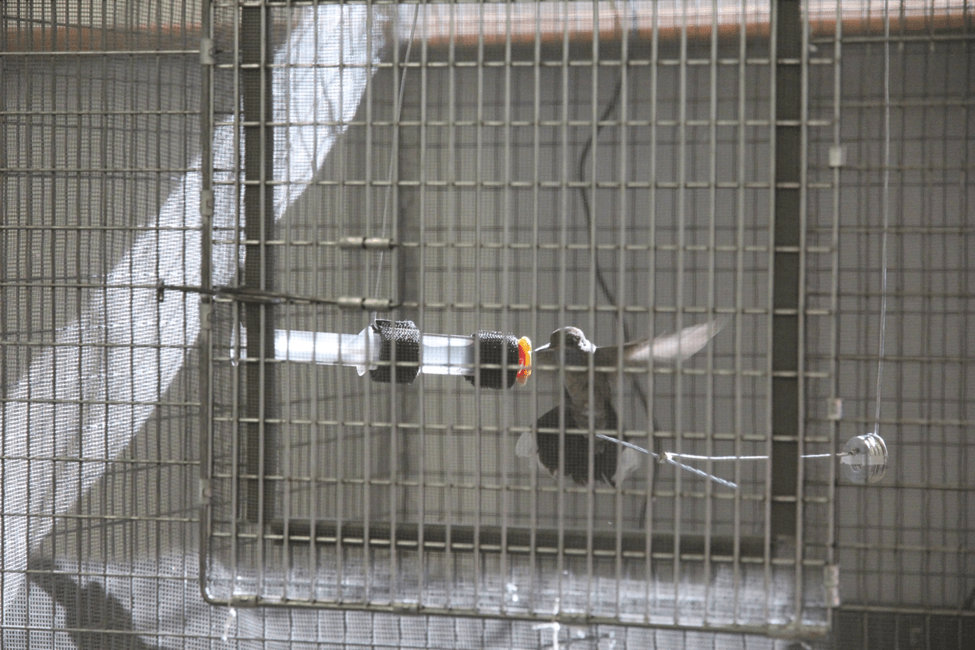
Throughout this project I have been constantly surprised by the results. Within the first field season as an undergraduate, working with hummingbirds for the first time, we already saw that all the species in Arizona can eat lots! The more species we studied, the more we saw a repeating pattern. The models we used allowed me to take the what of maximal feeding rates and put them in the context of why it might matter to a hummingbird and the plants they pollinate. It was only then that I began to understand the story the data were telling me. Once we paired these data with the other variables in the models, I was surprised by how variable foraging time budgets could be just based on the sweetness of nectar a bird may have access to.
About the author
This project started as purely a physiological experiment, investigating feeding rate as an undergraduate project. I collected data from four species in my first field season before graduating with my bachelor’s and wanting to pursue graduate school. I had a lot to learn about applying to graduate school, finding a good fit for an advisor and taking ownership to develop a project. I continued to collect feeding data during this stage, thanks to supportive collaborators and mentors. Though the process of writing was difficult and I hadn’t gotten the knack for school applications yet, this paper kept me curious. I started working with more collaborators who specialized in community ecology and plant-pollinator interactions. They are now co-authors on this paper, and their insight allowed me to see the physiological results through an ecological lens.
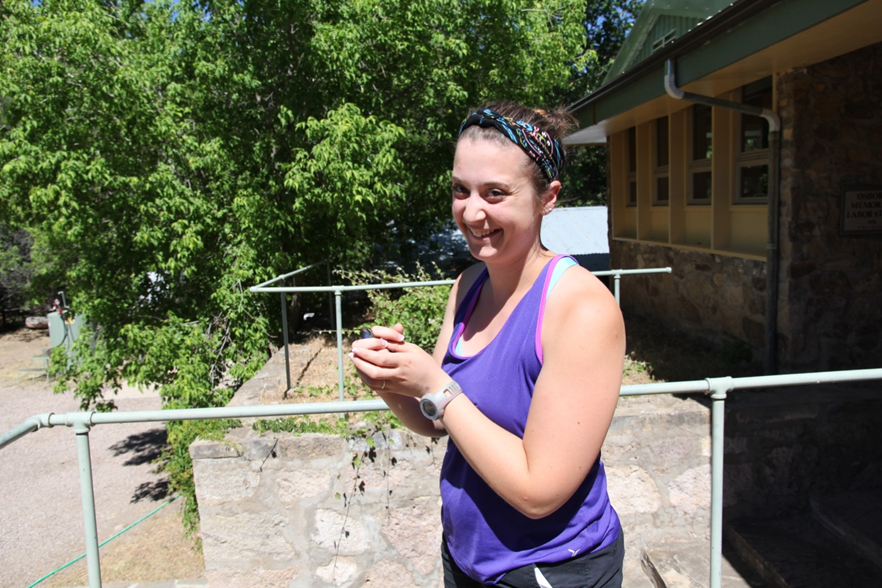
Upon reflection, if I were to give advice to that version of my past self, I would encourage myself to enjoy each stage. This is hard to do when transitioning between stages of a science career: you may want to be in the field but also need to pay the bills and figure out how to have health insurance! But I have learned so much from each phase of my science journey, even the phases where I was working at my coffee table after working two retail jobs simultaneously. My scientific curiosity was always there, but it takes diligence and a huge network of support to continue filling your toolbox and persevering. My mentors on this project deserve more thanks than I can give and ultimately, those connections are where I gained momentum to continue into academia. This paper has been more than the result of my first research project; it has been a familiar friend when I wasn’t quite sure where life would take me next.
I am now a PhD candidate at University of Montana, studying hummingbirds with Dr. Bret Tobalske. Instead of questions about how hummingbirds eat, I now spend my time exploring how they fly. I really have become obsessed with understanding the unique type of flight hummingbirds exhibit: they fly more like insects than many other birds, but when it comes to modeling the aerodynamics, they fall somewhere between a helicopter and a fixed wing aircraft! I have loved every day stretching my brain to understand the physical constraints of flight, and how these acrobatic flyers overcome gravity (and then some) with chasing and maneuvering in aerial contests!
