
We are flush with toilet paper options. I’m looking to minimize the environmental impact of every wipe, and it’s overwhelming.
I’ve been barraged with ads touting bamboo toilet paper’s environmental superiority to wood pulp counterparts. But my interest gave way to skepticism when I learned that all the bamboo used for toilet paper is grown in Asia. No bamboo toilet paper is “Made in the U.S.A.” from shoot to sheet.
I wondered whether growing bamboo in the United States would be environmentally better. After all, citrus growers have been venturing into bamboo farming after invasive pests and diseases decimated crops.
But the bottom line from ecologists: No.
“Planting bamboo in the southeastern U.S. is an absolutely horrible idea,” says David Coyle, an invasive species specialist at Clemson University in South Carolina. Bamboo’s carbon footprint has too many unknowns to calculate accurately at this point, and the ecological risk of invasion is high, he says.
Some already growing bamboo disagree. Bamboo can “absolutely” be controlled with the right choices, says bamboo grower Mark Sanders, who runs Ninth Ward Nursery in New Orleans. Risks can be mitigated by growing less aggressive species, pruning regularly and having barriers, Sanders and other growers say.
My simple ask for a greener wipe was becoming a complex quest. What is clear: While some bamboo farmers think there’s a path forward, some ecologists think introducing widespread, commercial-scale bamboo to the United States could be an environmental mistake — at least for now, given the lack of research or regulation.
Bamboo tends to stick around past its welcome
Bamboos are fast-growing grasses with more than 1,400 species, and they come in two types: running and clumping. Only a handful of species, mostly running, have been seriously cultivated for pulp.
North America has native bamboos, such as rivercane. These grasses are culturally important to some Indigenous groups, but foreign bamboos — mostly the running type — are more commercially viable. As their name implies, though, running bamboos send root systems far and wide. They generally pose a greater risk of becoming invasive than their clumping counterparts.
Whether running bamboo is planted intentionally or escapes a farm, “it is practically impossible to get rid of ” once established, especially at large scales, Coyle says. “Short of physically digging it up or, metaphorically speaking, nuking it with chemicals, it’s not coming out.”
It’s so difficult that Sanders, who conducts bamboo removals as part of his business, typically refuses jobs that involve running bamboo, because he can’t guarantee complete removal.
That difficulty translates into an ecological threat, says Luke Flory, an invasive species ecologist at the University of Florida in Gainesville.
“The biggest risk comes not from current production or managed land,” Flory says. “It’s if these companies go bankrupt and their tens, hundreds or thousands of acres of bamboo are just left there.” An almost total lack of regulation or oversight on planting bamboo exacerbates the invasion risks, he says.
Still, some farmers are wholly optimistic about bamboo.
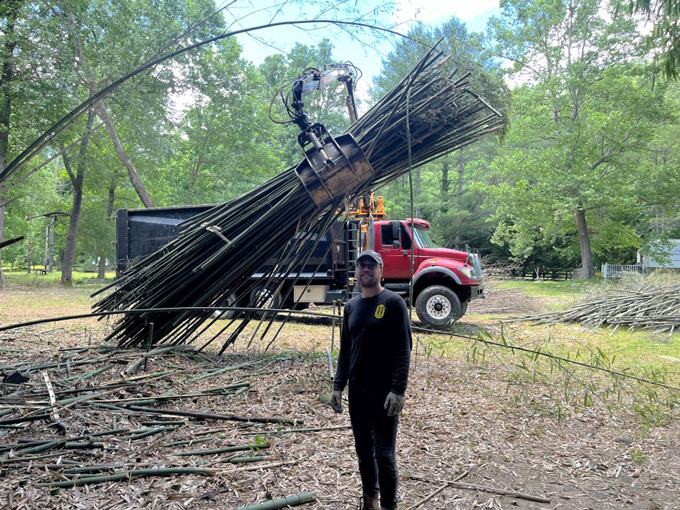
Entrepreneur Jamie LeLiever runs North Carolina–based National Bamboo, which works with bamboo growers managing more than 300 hectares throughout the Southeast. The company is among the first working to turn U.S. bamboo into pulp for paper and other applications at its Shelby processing facility.
He thinks by starting with the right species, he can avoid the sticky “invasive” problem. After tracking the progress of different bamboo test crops, he chose Phyllostachys nigra ‘Henon,’ a running bamboo native to China. It had the right composition to make paper pulp without being too finicky to grow, and its seeds are sterile, which should reduce invasion risk. His company has been growing it for about five years.
“Every year, it’s creeping a max of [about two meters],” LeLiever says. His growers maintain six-meter buffers around fields, which are mowed annually to stop new shoots from establishing based on several years of observations.
Flory is skeptical that mowing can stop bamboo’s spread. He says it can take decades or centuries for an introduced species to become invasive. Because bamboo is ecologically new to the region, farmers probably haven’t experienced the plant’s full invasive potential.
“The longer a nonnative species has been introduced to an area, the more likely it is to be invasive,” Flory says. Just because producers haven’t seen it yet doesn’t mean it can’t happen.
Deah Lieurance, an invasion ecologist at Penn State, has conducted risk assessments on bamboo and wants to see farmers succeed. It “was really hard to watch” citrus growers lose longtime family businesses to pests and disease, Lieurance says. “I was always rooting for the farmers … and bamboo, just to me, wasn’t the right answer based on the data I saw.”
Bamboo’s comparative carbon footprint is murky
Part of bamboo’s allure for me involved its advertised carbon impact. Many bamboo paper product companies have phrases like “tree-free” splashed across their websites, paired with photos of lush forests being logged for your tush. Some promise that customers can reduce carbon emissions compared with wood pulp options.
“I don’t think they can make the claims they’re making,” Lieurance says. Little research exists on how carbon storage differs between bamboo forests and traditional pulp tree forests, and the few studies there are generally find little difference between alternative pulps and recycled paper.
One 2025 study in Cleaner Environmental Systems compared the carbon footprints of bamboo and traditional wood-based bath tissue, including factors such as growing, manufacturing and shipping. Those researchers found that the average footprints are similar and even concluded that refining existing wood-based tissue technology could lessen TP’s environmental footprint more than pursuing bamboo. They did not consider the case of bamboo grown in the United States, but noted that growing locally could change the carbon calculus.
Similarly, a 2019 study in the Journal of Advanced Manufacturing and Processing found that differences in environmental impacts of the pulping and papermaking processes were “generally not large” between traditional and alternative sources, including bamboo, and that alternative pulps had similar environmental impacts as recycled products.
Having more life cycle analysis studies and doing more research into how carbon is stored in different kinds of forests and with different harvesting practices could make product comparisons clearer and more scientifically robust, Lieurance says.
At least one company does provide carbon footprints for their products, but most don’t. For now, then, Lieurance says, bamboo TP companies are mostly “hanging their hat on how fast it grows,” implying that speedier growth means that bamboo plants can lock away carbon dioxide more quickly than forests.
And now, the bottom line
There’s still uncertainty because of opaque environmental reporting, variability in energy grids and a paucity of research, but recycled TP may come out a swipe above bamboo.
The Natural Resources Defense Council, an international environmental nonprofit headquartered in New York City, ranks the sustainability of toilet paper options based on factors like postconsumer recycled fiber content, fiber type and whether the source is associated with deforestation. In agreement with a few life cycle studies, they generally score recycled products with an “A,” above bamboo’s grade of “B.” Traditional TPs get a “D” or lower.
For now, the TP aisle choice comes down to what matters more to you: buying U.S.–made, avoiding TP made with new tree material or having the plushest possible wipe.
LeLiever’s a bamboo believer. He thinks that 2 million hectares of bamboo could be grown across the South by 2040 if a domestic supply chain can be established, and that U.S.–grown and made bamboo toilet paper may be only a few years away.
But these ecologists would like bamboo to stay abroad.
“We don’t know a lot, unfortunately,” Coyle says. “I do all I can to get people to not plant bamboo because it’s a road that when you go down, there’s really no turning back.”
My bathroom, at least, will be bamboo-less. On to the next quest: finding the softest 100 percent recycled TP.