
It’s 5:45 p.m. and you’ve just arrived home after a long day at work. You’d like nothing more than a glass of pinot and to binge old episodes of your favorite show. Into the kitchen comes young Sally, your food-adventurous 8-year-old. “I’m hungry, what’s for dinner?”
Sally has never met a food she’s afraid to try. Visions of her savoring the tangy brine of an oyster and joyously slurping spicy ramen noodles dance in your head.
Before you can give her an answer, Billy, your 4-year-old picky eater, shouts, “Mac and cheese!” from the living room. Billy rotates between three entrées: macaroni and cheese from a box, chicken nuggets (only dino shaped) and pasta (only spaghetti).
You sigh and wonder how such diverse creatures ended up in the same family.
If this scenario rings a bell, you are not alone. As a nutritional neuroscientist and a parent, I have spent the better part of my professional and personal life thinking about why children eat the foods they do.
Understanding how food preferences develop can help parents teach kids to enjoy a diverse, varied and healthy diet.
Nature vs. nurture?
Are genes to blame in the case of picky eaters like Billy? While genes can have some influence, they often explain only a small part of the story.
People are born liking the taste of sweet and disliking the taste of bitter. These traits are thought to be protective in that they can help drive someone toward sources of calories – which are often sweet, such as fruits or breast milk – and away from potential toxins or poisons, which are often bitter. As an example of these innate preferences, one study found that pregnant moms who consumed sweet carrot capsules had babies who smiled on the ultrasound, while those who ingested bitter kale capsules had babies who grimaced for the camera, suggesting early on their dislike for bitter vegetables.
Milky Way/Moment via Getty Images
In addition to these innate responses, there are genes that affect your ability to taste bitter compounds. These compounds, called thioureas, are similar to those found in cruciferous vegetables. People who inherit genes that make them sensitive to these bitter compounds – about 70% of the U.S. population – tend to also be more sensitive to other bitter tastes in foods. Because of this, they may dislike foods such as raw broccoli, black coffee and grapefruit.
However, there are plenty of people who develop a liking for bitter foods, even though their first experience with them might have been unpleasant. Case in point, the growing popularity of bitter IPA beers.
Another gene that can influence food preferences is the gene that makes cilantro taste soapy. Those born with a version of this olfactory gene – up to 20% of the U.S. population – are sensitive to aldehyde compounds that tend to taste soapy. Because of this taste, they often dislike cilantro.
Pavlov and food preferences
While genes by themselves explain only a small part of taste, a person’s interactions with food in the environment are particularly influential when it comes to what they want for dinner.
Ivan Pavlov was a 19th-century experimental physiologist who showed that dogs could be taught to salivate at the sound of a bell. He put them through a conditioning period in which mealtime was repeatedly paired with the sound of a bell. Most pets have some ability to learn to associate environmental cues – such as a food bowl or the sound of their owners’ commands – with food.
In the early 1980s, psychologist Leann Birch conducted a series of studies showing that people develop food preferences using a process similar to Pavlov’s classical conditioning. When the taste of a food is associated with positive experiences – such as an influx of calories, release of reward chemicals in the brain or the pleasing tones of a mother’s voice – these positive experiences can enhance how much a person likes a food. On the other side of the coin, negative experiences, such as a painful stomachache or a punishment associated with eating a food – “You have to eat all of your vegetables or no screen time!”– can often decrease how much someone likes a food.
Babies even begin learning about food before they are born. In a classic study by biopsychologist Julie Mennella, pregnant moms who drank carrot juice four days a week during their pregnancy or while breastfeeding had babies who were more accepting of carrot-flavored cereal when it was first presented to them. Flavors that are passed through amniotic fluid to the developing fetus prime the future baby to accept the cuisine of the family.
Catherine Falls Commercial/Moment via Getty Images
Hope for picky eaters
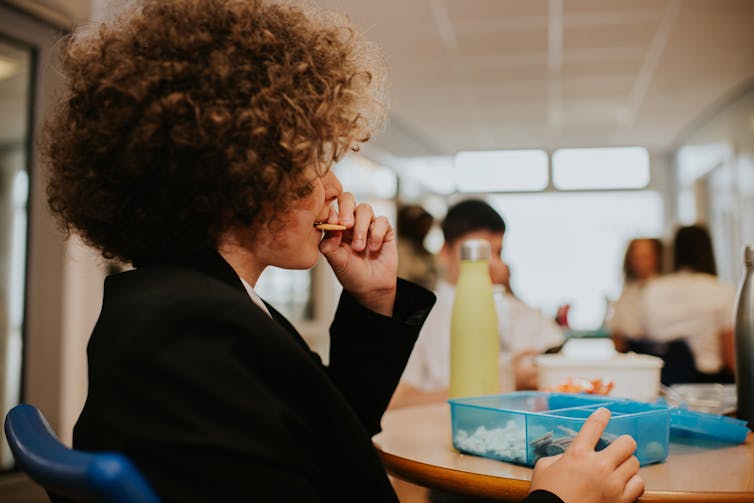
The good news is that for most children, picky eating is a phase that tends to decline as they reach school age. And if children are growing at a healthy pace, it’s often not something to be too concerned about.
For parents who want to help their kids expand their palates, the most important thing you can do is give your child repeated opportunities to taste foods without pressuring or coercing them. Some children need 12 or more taste experiences with a new food before they will accept it. Some children will also be open to trying foods at school or day care, even if they won’t try them in front of you.
As for Sally and Billy, you’ve managed to get dinner on the table right on time. Your latest invention: kimchi mac and cheese and baked cauliflower, with extra Sriracha for Sally. You’re hoping the familiar shape of the boxed mac and cheese noodle might tempt Billy into taking a bite. And if not, there’s always tomorrow.
