
It was a typical Florida story. In January 2014, Missy Williams stood at the edge of a park-and-fly in Dania Beach near Fort Lauderdale-Hollywood International Airport. She watched the boundary where a chain-link fence stood between a strip of mangroves and the parking lot. Williams waited. Less than 20 minutes later, she saw them: wild African vervet monkeys climbing the fence.
“I was just in a state of awe,” Williams recalls. “I couldn’t believe it was really happening.”
Then a graduate student at Florida Atlantic University in Boca Raton, Williams had been preparing to travel to Gombe National Park in Tanzania to study wild monkeys. But as the mother of a young boy, Williams was finding balancing foreign fieldwork and childcare difficult. Then, a Miami local mentioned that there might be wild primates closer at hand.
That conversation led Williams to the airport, and her chance meeting in the parking lot sparked a love affair — one that has made her the number one advocate for one of South Florida’s best kept secrets.
No primates, aside from humans, are native to the United States. But at least 10 species of primates have been introduced to the country since 1930. In Florida, three species of monkeys have established breeding populations. Among them are the Dania Beach colony, a small population of vervet monkeys that has lived in and around the city’s mangrove forest for nearly 80 years.
“It’s pretty cool to have wild monkeys in your backyard.”
Kyle Jones
Brewery Operations Manager
Despite their nonnative status, this colony is beloved by some Dania Beach residents. They are fed by office workers, mentioned in megachurch sermons and are even mascots for local beers. But their continued survival is threatened. Monkeys are frequently run over by cars, electrocuted or simply disappear — potential victims of the illegal exotic pet trade. And according to Williams’ research, the Dania Beach colony will likely go extinct within the next century.
Some local residents, including Williams, are now advocating for the colony to be protected. These wishes run counter to federal and state policies, which aim to remove or manage nonnative species of concern. The Florida Fish and Wildlife Conservation Commission considers the Dania Beach vervets an invasive species because of their potential to have negative impacts on native wildlife, ecosystems and agriculture.
“Nonnative species do not belong in Florida’s environment,” Commission spokesperson Lisa Thompson said to Science News in an emailed statement.
Some invasive species researchers are also dubious about proposed protections for the monkeys. “People probably feel drawn to primates because they’re cute and fuzzy,” says wildlife ecologist Steve Johnson of the University of Florida, Gainesville. But monkeys and other introduced species, he says, “will never be native to Florida.”
Whether these vervets survive largely depends on how they are perceived. Are they valued Dania Beach residents? Or are they a nonnative threat that should be allowed to slowly vanish into extinction? And who gets to decide which view about these monkeys matters more?
Invasive science is born
There is nothing new about people transporting other species to novel environments. As far back as 5,000 years ago, hunter-gatherers brought the dingo — a type of feral dog — to the islands of New Guinea and Australia from mainland Southeast Asia. Across centuries, people have carried plants, microbes, fungi and animals with them on their journeys around the globe.
The rate of species exchange has only increased. In the last few hundred years, “humans have become extremely good at moving things,” says Martín Nuñez, an invasion biologist at the University of Houston in Texas. Airplane and boat travel have introduced species to one another that evolved over millennia in isolation. Sometimes these meetings have had disastrous consequences.
Take the infamous chestnut blight. The American chestnut (Castanea dentata) was once the dominant tree type in U.S. eastern forests, a key food source for people and animals and so common that many streets still bear the name. But the arrival of a fungus from Asia sometime around the turn of the 20th century devastated the keystone species. Today, the species is considered functionally extinct.
Scientists recognized the breadth of invasive species’ impact only relatively recently. In 1980, ecologists gathered for a conference in South Africa to talk about threats to Mediterranean ecosystems. It didn’t take long for researchers to realize that the bulk of their presentations centered on the impact that introduced species had on their various study sites. That conference helped launch a global effort to understand how introduced species were reshaping not just local ecosystems, but the world.
This work “started a real science of invasions,” says ecologist Dan Simberloff of the University of Tennessee in Knoxville.
By pooling their data, researchers found that most newly introduced plants and animals quickly perished upon arrival or never established a breeding population. But a handful of newcomers survived — and even thrived — in environments without established predators or diseases to keep their populations in check.
Any species introduced to a new ecosystem by people is considered nonnative. These introduced species only become invasive when there is evidence that they can, or do, bring harm to human health, the environment or the economy. There is no established method for determining whether a species is invasive, but there are some general signposts, including when a species rapidly spreads from its area of introduction, or evidence of a species outcompeting or actively preying on native species.
Nonnative species can also earn the invasive title if they are considered pests, such as the emerald ash borer (Agrilus planipennis), which likely arrived in North America from Asia during the mid-1990s and is reviled for the damage the insect has done to the continent’s ash trees.
Today, the International Union for Conservation of Nature considers invasive species to be one of the biggest threats to biodiversity and a major driver behind extinctions. Invaders are also expensive. From 2010 to 2020, invasive species cost the U.S. economy around $21 billion a year in agricultural loss, forestry issues and other management costs, researchers reported in 2022 in Science of the Total Environment.
In 1977, then-President Jimmy Carter had signed an executive order that forbade new species from being released on federal lands and waterways. But it was too little, too late. The executive order was powerless against people bringing nonnative species onto private or state property. And by then, hundreds of species had already made their way into the country — with more to come.
Florida is one of the nation’s hot spots for invasive species; it is now home to over 600 nonnative species. At least 139 of these are established and breeding in the wild, according to the Florida Fish and Wildlife Conservation Commission.
Part of the agency’s job is to manage existing nonnative species and prevent new introductions. Some of the species managed by Florida Fish and Wildlife — such as the invasive Burmese python (Python bivittatus) — are highly publicized by the media and are the targets of mass management campaigns.
But the sheer scale of the problem means that many introduced species can’t be prioritized or simply fly under the radar. For instance, that small colony of vervet monkeys in South Florida.
The great escape
Vervet monkeys are well suited to the invasive lifestyle. Six species of vervet monkeys, belonging to the genus Chlorocebus, live across sub-Saharan Africa. Most species are thriving and can be found anywhere from the savanna to dense city centers.
The success of this genus, especially at a time when many animal species are threatened, can be tied in part to their adaptability. Vervet monkeys are omnivores, live in flexible social groups, are quick learners and can survive pretty much anywhere they have access to trees, water and warm weather, Williams says. Their flexible lifestyles allowed early escapees to colonize several Caribbean islands starting in the 1600s, where they continue to raid farms and charm tourists to this day.
Primatologists have studied vervet monkeys for decades. But when Williams started her Ph.D. research in 2014, next to nothing was known about the Dania Beach colony. A literature review revealed just one paper written on the topic: a 1995 study published in Florida Scientist that counted 36 vervet monkeys in Dania Beach of suspected East African origin.
Everything else was a mystery. How had African monkeys made their way into Florida? And what did people think of them?
Williams set out to answer these questions will the help of her Ph.D. advisor at Florida Atlantic University, Katie Detwiler. As a primatologist, Detwiler was accustomed to traveling outside of the country to study free-roaming primates. Having wild primates so close at hand seemed like an incredible opportunity, she recalls.
However, habituating the monkeys to their presence was hard work. The team had to ask for permission from landowners to access the mangroves — and many were reluctant to give it.
“The whole area has known about them for a very long time, and they protect them,” Detwiler says. Some landowners worried that the scientists would harm the colony or try to trap them for biomedical research (another of Florida’s nonnative monkeys, rhesus macaques, have been trapped and sold to labs). One particularly reluctant business owner was so protective of the monkeys that he’d previously dropped the basket of a backhoe onto the car of a suspected trapper.
Monkeys on the move

Genetic samples from the Dania Beach monkeys helped scientists trace their origins to West Africa (highlighted area of the inset map). Monkeys from this region are also found scattered across the Caribbean.
The wild monkeys were also extremely nervous around people, and sneaking up to them proved next to impossible in the muddy, sulfuric, insect-ridden mangroves. The team lost shoes and much of their sanity before deciding to stick to the parking lots, which the monkeys also patrolled.
With time, Williams habituated some monkeys to her presence. She was also starting to make headway with the Dania Beach community, who started to refer to her as “the monkey lady.” Interviewing residents was key to answering one of Williams’ most pressing questions: Where had the colony come from?
Newspaper clips suggested the monkeys had been around since at least the 1950s. Her interviews with older residents eventually led Williams to investigate a biomedical research organization–cum–zoo that used to import primates from West Africa. The organization was opened in 1939 by Leila Roosevelt Denis, first cousin to President Theodore Roosevelt. Primates from the center were sold to private universities and the National Institutes of Health for polio and tuberculosis research, as well as the Air Force for early space flight studies.
In 1947, 50 monkeys ran off into the surrounding mangroves after a zookeeper either failed to properly lock a cage or the imprisoned monkeys figured out how to jerry rig the door. Most were eventually recaptured. But around 15 were never accounted for.
The timing of this disappearing act suggested to Williams that this was the founding population for the Dania Beach colony. But the story didn’t line up with the 1995 study suggesting that the colony was made up of hybrids from two vervet species originating in Uganda, in East Africa.
Williams collected DNA from fecal samples and one dead monkey. The DNA soon confirmed what Williams suspected: The Dania Beach monkeys belong to the vervet species Chlorocebus sabaeus, otherwise known as the green monkey, which can be found from Senegal to Ghana in West Africa. The ancestors of these monkeys, it seemed, were indeed the lucky escapees of the biomedical trade.
Living on the edge
It’s a beautiful October day in Dania Beach, and the setting sun is filtering through the tops of the mangroves when Williams calls me on FaceTime. We’re going to see some monkeys.
Williams finished her Ph.D. research in 2019. She now works as an adjunct professor at Florida Atlantic University, where she’s helped some students access the Dania Beach colony for research projects. Williams is also the director of the Dania Beach Vervet Project, a nonprofit that advocates for the protection of the Dania Beach colony.
Scientists are often uncomfortable with outward displays of affection for their research subjects. That’s not the case for Williams. Her “interest in the beginning has always been in animal welfare,” Detwiler says.
In 2022, Williams opened a 3.5-acre sanctuary at the same spot where she first saw the colony over 10 years ago. Wooden enclosures wrapped in chicken wire are now the permanent homes of eight vervets. Most are surrendered pets, but two — Spock and Betty — were born in the mangroves just outside their enclosures.
Williams approaches the enclosure that Spock and Betty share with a surrendered pet, Margarita. Spock, the old man of the group, is tearing apart a cardboard box in search of a snack. It’s a bit unusual for him, Williams says. “Spock is a lazy forager. Normally, he’ll wait for the girls to open it, and then he swoops in to take the goods.”
Betty gets up from the swing where she’s been lazing and climbs down toward Williams. She’s fast-moving, despite her missing leg and amputated tail. “Hi, Betty!” Williams calls out in a sing-song voice. Betty reaches through the chicken wire trying to grab Williams’ smartwatch.
Betty was one of the sanctuary’s first residents. As an infant, she was electrocuted while climbing a utility pole. She would likely have died without veterinary care, Williams says.
There are few medical options for a member of a nonnative species like Betty. Before the sanctuary opened, most injured monkeys “were basically neglected,” Williams says, and were either euthanized or given to a breeder.
“I don’t think that it’s fair that just because they’re a nonnative species, that they should be maligned.”
Missy Williams
Primatologist
Betty is far from alone in her infirmities. Many of the Dania Beach monkeys sport injuries. One wild monkey, dubbed Baby Billy after a character in the TV series The Righteous Gemstones, self-amputated an arm after getting electrocuted. Other monkeys have been maimed or killed by cars.
These constant injuries might explain why the population hasn’t grown much in over a decade, Williams says. Green monkeys are among the select 22 percent of primate species that aren’t considered threatened or endangered by the IUCN. Females can give birth once a year, usually to a single infant, and Caribbean islands have borne witness to how their population can boom under the right conditions. For example, the island of St. Kitts — just 176 square kilometers — could be home to more than 37,000 green monkeys.
But the Dania Beach colony isn’t growing. In fact, it’s likely to shrink in the coming decades. A population model run by Williams in her thesis counted 41 monkeys split between social groups, a measly 14 percent increase compared to the 1995 count.
Williams’ work suggests that the colony will go extinct within a century, with most models averaging extinction in around 50 years.
Williams has mixed feelings about this finding. On one hand, it means that the monkeys are unlikely to expand outside of their current range — something that might earn them a bad reputation if they start showing up where people think they shouldn’t be.
That’s what seems to have happened in St. Kitts, where green monkeys are now considered invasive and are a major priority for removal by the government. The population was previously controlled by the sugar industry, which routinely shot green monkeys. But the end of large sugar plantations around 2005 led to a population explosion, and today, green monkeys routinely raid and damage half of all farms on the island.
Dania Beach’s vervets have escaped censure in part because there simply aren’t enough of them to be considered pests, Detwiler says. They don’t raid farms or garbage bins. Keeping a lid on their growth could help keep them in their human neighbor’s good graces.
But for Williams, it’s also bittersweet to imagine the mangroves empty of vervets. “I love them,” she says. “I don’t think that it’s fair that just because they’re a non- native species, that they should be maligned.”
Beloved neighbors
“Maligned” isn’t the best way to describe how Dania Beach residents typically feel about the wild monkeys. For one thing, most people simply don’t know they exist, says Eugen Bold, former director of policy and public affairs for Broward County, Fla.
People who do know about the monkeys tend to greet their primate neighbors with delight. In an anonymous survey Williams ran from 2015 to 2018, 70 percent of over 230 respondents said the monkeys were “openly welcomed.” Only 7 percent said the monkeys shouldn’t receive protection because of their nonnative status.
This lines up with Bold’s experience. While working for the county commissioner, Bold sometimes received calls from residents worried about the monkeys’ welfare. Concerns about the monkeys — such as their risk for passing on disease — were few and far between, he says.
“It’s pretty cool to have wild monkeys in your backyard,” says Kyle Jones, cofounder and operations manager of LauderAle Brewery & Tap Room, one of the businesses that backs up against train tracks where the vervets roam. People sometimes show up at the brewery asking to see the monkeys, and he hosts fundraisers for the sanctuary.
This goodwill doesn’t just extend to tolerance. Some Dania Beach residents want the monkeys protected — including Bold, who is now running for Broward County commissioner. If he wins the election in November, Bold sees the colony as a “great opportunity” to incorporate the county’s “unique history” into the areas’ public education system, which currently serves nearly 250,000 students.
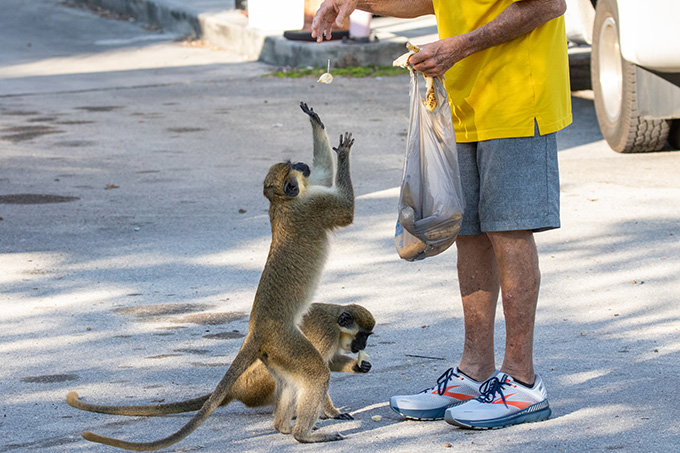
In contrast to the current Florida Fish and Wildlife stance, “I would redefine them as Florida wildlife,” Bold says.
Not everyone is thrilled with this take.
“For me, it’s wrong,” says Nuñez, the invasive species biologist from the University of Houston. Nonnative species — even beloved ones — can make life extremely difficult for native species. For instance, free-roaming cats in North America kill somewhere in the realm of 1.3 billion to 4 billion birds a year in the U.S. alone. Even if there isn’t current evidence that the vervets are causing harm to Florida’s mangroves, “we don’t know the real impact” they are having now or will have in the future, Nuñez says.
He adds that it isn’t unusual for people to become attached to nonnative species. People can hate native species like mosquitoes even while they feel deep affection for the nonnative ornamental plants in their gardens.
These emotions can translate into policy. Take feral horses in North America, which were brought over from Europe by Spaniards sometime in the 1500s. More than 73,000 wild horses now roam on land overseen by the U.S. Bureau of Land Management. Some research suggests that they graze on native plants and contribute to soil erosion. But the cultural associations between horses and the American West — along with concerns for their wellbeing — mean that feral horses are protected under federal law.
Something similar may be at work in Florida, Nuñez says. No one is currently calling for removal of the Dania Beach monkeys. But an attempt to remove Asian rhesus macaques in the state’s Silver Springs State Park between 1988 and 2012 was met with fierce opposition. The sympathy people feel for monkeys may spare Dania Beach’s population from any attempt to remove them, and may even spur people to actively protect them.
Oh, the humanity
Then there’s the fact that Williams isn’t so sure that the Dania Beach vervets meet the definition of an invasive species. For one thing, the population isn’t growing, probably because “there’s no place for them to go,” Detwiler says. The area around the mangroves is so developed that monkeys cannot easily spread from their original habitat.
Meanwhile, it’s still not clear how the monkeys impact the local ecosystem. Locals sometimes call the vervets “bougie” because of their picky eating habits — unwilling to eat lettuce, tomatoes or shortbread cookies, which their counterparts in West Africa would be glad for, Williams says.
These picky habits seem to extend to foraging. One of the ways that scientists establish whether monkeys are invasive is by seeing whether they take eggs from nests. One study of Silver Springs’ rhesus macaques found that those monkeys did go after quail eggs placed in the wild, which implied they could also go after the nests of native species.
But a similar study conducted by one of Williams’ students found no evidence that the vervet colony was going after eggs in the mangroves. Instead, the most frequent egg raiders were native raccoons.
Which isn’t to say that the Dania Beach monkeys don’t go on raids. Williams calls me while I’m walking back to my bike after running errands in mid-October. Some free-roaming moneys are paying Williams’ sanctuary a visit. It’s part of their daily foraging routine, one that involves harassing the sanctuary’s resident monkeys through the chicken wire.
On the call, monkeys line up on the roof of the sanctuary’s office shed, peering down at the camera. Williams shows me each of their faces, naming them one by one.
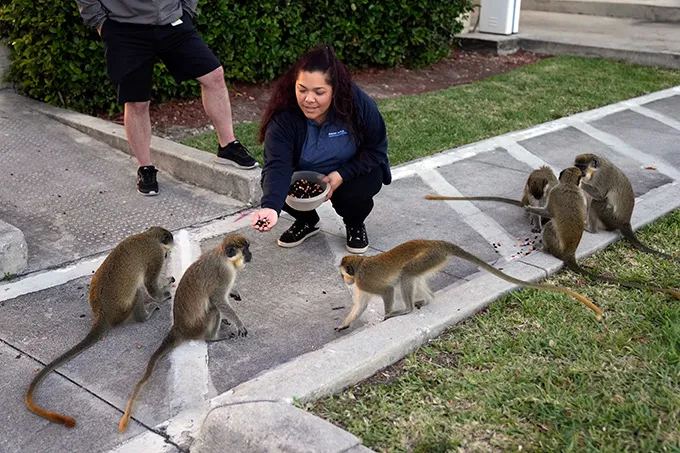
As with all introduced species, the ancestors of these monkeys were brought to Florida by people. And with that involuntary relocation, the survival of the Dania Beach vervets is now in human hands.
To Williams, it’s clear that her vervets are “100 percent just nonnative” rather than invasive. In an ideal world, Williams would like the monkeys to be “grandfathered in” as a new native species to Florida. “If the science and the data say, ‘Hey, this is going to be OK, they’re not going to become invasive,’ then why not make an exception?” she says.
Other scientists aren’t sure it’s that simple.
“The field has discovered more and more impacts that are subtle and hadn’t been recognized right away,” Simberloff says. The true impact of the vervets on the mangroves — one of Florida’s most endangered ecosystems — may not yet be obvious.
Still, whether the monkeys are invasive may be a moot point for Dania Beach residents, and ultimately, how the colony is managed. “Could you shoot a monkey?” Simberloff asks. “I couldn’t.”