
As if leopards and saber-toothed cats weren’t enough, some ancient human relatives probably also had to contend with predators that swooped down from the skies.
Adult male baboon remains found in Africa carry telltale signs of raptor predation. The specimens probably weighed about 22 to 26 kilograms in life. That’s twice the size of the largest primates previously known to be preyed upon by a raptor species and on par with some early human ancestors, researchers report November 18 in the American Journal of Biological Anthropology. Guarding against aerial predators may have pressured humans’ ancient cousins to form tighter social groups and develop vocal strategies that preceded language, the researchers say.
Biologists discovered the baboon bones among the high sandstone cliffs of Ennedi Plateau in northeastern Chad. These baboons (Papio anubis) have developed unique survival strategies, such as scaling 50-meter cliffs and digging for water and food. They share the plateau with multiple birds of prey, and the researchers have identified one as the most likely baboon hunter: the Verreaux’s eagle (Aquila verreauxii).
Researchers have long studied predation from land carnivores such as big cats and crocodiles as a primary driver of behavioral changes in primates, including human ancestors. While a five-kilogram bird like a Verreaux’s eagle taking down a 22-kilogram monkey may seem unlikely, the raptors appear to have developed specialized hunting techniques.
“It’s pretty brutal, but it’s pretty quick,” says Cat Hobaiter, a primatologist at the University of St Andrews in Scotland. The eagles stab their talons “straight through the eye, straight through the brain, and that’s a very effective control and kill.” The birds may also drag the baboons off the cliffs, a strategy that golden eagles use to hunt large mountain goats and sheep in the Alps. The birds then dismember the prey and carry off pieces to their nests.
Three adult male baboon skulls that Hobaiter and her colleagues studied had clearly visible punctures through the eye sockets. And two specimens also had gashes across the shoulder bones, which appear to have been made by grasping talons. The researchers estimated the weight of the animals based on the size of the head of their femurs, where these upper leg bones attach to the hip.
Catherine Hobaiter
While the punctures could come from something other than an eagle’s talon, such as a bite or a bullet, the clean circular holes in the skulls match similar damage to smaller monkeys hunted by eagles, Hobaiter says.
“I found the evidence pretty compelling,” says Scott McGraw, an evolutionary biologist at Ohio State University in Columbus who was not involved with the work. The punctures look “remarkably similar” to injuries in monkeys hunted by the African crowned eagle in the Taï Forest of Côte d’Ivoire, McGraw says.
The eagles also use the landscape to their advantage, hugging cliffs to stay hidden and possibly hunting in pairs, Hobaiter says. It’s possible that one eagle could distract the baboons from above while another swoops up from below a cliff to attack, as has been observed against other prey, she says.
While the research team did not witness an eagle attack a baboon, they did observe the monkeys responding to the Verreaux’s eagles’ presence, though not to other raptors in the area.
When the eagles flew down over a ridge, the baboons immediately barked out an alarm call and climbed over the edge of a cliff to safety, Hobaiter says.
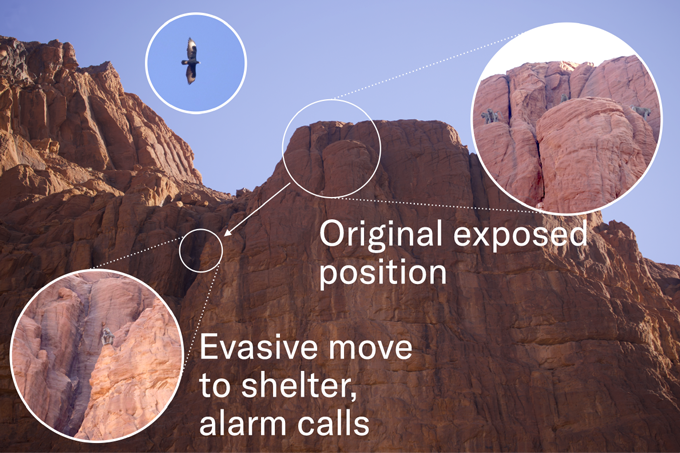 A Verreaux’s eagle flies overhead, prompting a group of baboons to drop down to a lower ledge of the cliff for safety.
Catherine Hobaiter
A Verreaux’s eagle flies overhead, prompting a group of baboons to drop down to a lower ledge of the cliff for safety.Catherine Hobaiter
The eagles’ ability to hunt large primates suggests that raptors may have also hunted ancient human ancestors, Hobaiter says. In particular, the genus Australopithecus, which lived about 4 million to 2 million years ago and included the famous fossil named Lucy, had similar body sizes to the baboons. A 2.8-million-year-old skull called the Taung child from the species A. africanus even has puncture and scratch marks that McGraw and other researchers argue probably came from a raptor.
The threat from birds of prey paints a more complete picture of how and why our ancestors developed certain behaviors, such as social grouping to protect younger animals. Primates also use a range of vocal alerts to warn the group of danger. They use different sounds or combinations of sounds for different threats, such as a predator on the ground or in the sky.
“Those first steps towards combining information in different ways to be more specific … would have been a really important precursor [of language],” Hobaiter says.