
A recent archaeological study has renewed interest in the role of animals within the ceremonial and urban landscape of ancient Tenochtitlan.
Tenochtitlan was the capital of the Mexica (Aztec) civilisation, situated on a raised islet in the western side of the shallow Lake Texcoco, which is now the historic part of present-day Mexico City.
The study, published by archaeologist Israel Elizalde Méndez as part of the Templo Mayor Project, analyses zoological remains recovered from ritual offerings associated with the Huei Teocalli, the primary temple complex dedicated to the gods of war (Huitzilopochtli) and rain (Tlaloc).
Mendez examined 28 animal specimens from six species: a golden eagle, harpy eagle, quail, jaguar, wolf and roseate spoonbill, all recovered from eight ceremonial offerings.
Detailed palaeopathological analysis of disease, trauma and stress-related skeletal markers was used to assess whether the animals had been kept in captivity before their ritual deposition.
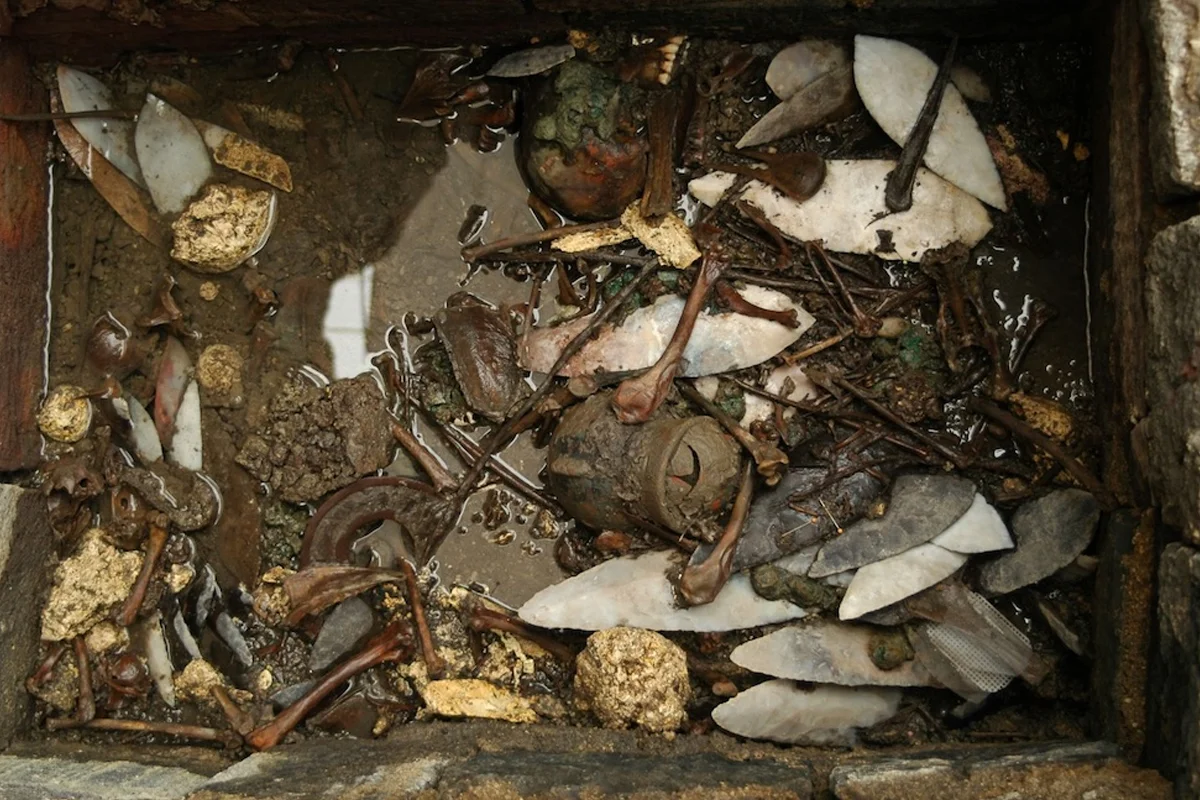
Based on the joint degeneration, healed fractures, infections, and other pathological conditions, Mendez concluded that many of the animals would not have survived in the wild, strongly indicating sustained human care consistent with confinement and feeding by humans.
The study also addresses the long-debated existence of a vivarium in Tenochtitlan, often referred in historical sources as “Totcalli”, a zoo constructed during the reign of Moctezuma II – described as housing multiple sorts of animals, mainly avian species, but also several predatory animals.
Although no architectural evidence for such a structure has been found, the osteological information provides indirect but convincing support for its existence.
Beyond zooarchaeology, the publication situates animal captivity within the broader Mexica cosmological framework. Animals served as symbolic intermediaries in ritual living, standing in for cosmic levels of sea, land, and sky, to feed the deities. The fact that they were maintained in the city before ritualisation highlights the religious and ideological significance of captivity.
Sources : INAH