
In this ‘Behind the Paper blog post, author Elena Tello-García – a postdoctoral researcher at the University of Innsbruck – discusses “Shrub encroachment influences root traits and mycorrhization in subalpine grasslands“, which was recently published in Functional Ecology. Elena discusses how shrub encroachment reshapes root traits and mycorrhizal partnerships in mountain grasslands, the endless root washing required during fieldwork, and the benefits of a good humored, supportive team.
About the paper
Due to a reduction on grazing intensity and climate change, shrub encroachment has become a common phenomenon in many mountain ecosystems and specifically in European subalpine and alpine summer pastures. The effects of shrub encroachment have been more studied aboveground, where it is known to change species composition and ecosystem functions. However, the belowground side is far less studied. Therefore, in this study, we aim to test how shrub encroachment reshapes root traits and mycorrhizal partnerships in mountain grasslands. We examined how belowground patterns change along a gradient of increasing shrub encroachment, testing whether shrubs alter the strategies of herbaceous plants and the whole community, and whether root traits and mycorrhizal partnerships align with the root economics space.
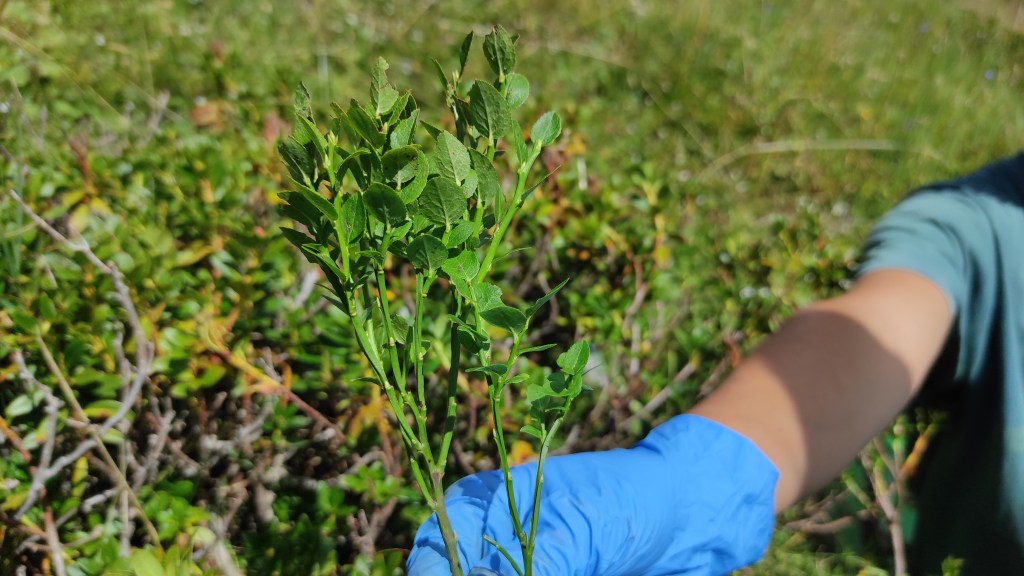
We found that shrub encroachment does have an effect belowground, with herbaceous shifting toward tougher, more resistant roots and relying less on arbuscular mycorrhiza. At the community level, root toughness, soil exploration ability and arbuscular mycorrhizal colonization dropped, offset only by a slight increase in ericoid mycorrhiza, typical partner of ericoid shrubs. Herbaceous plants followed the expected root economics space, moving from a more acquisitive to a more conservative strategy, but community level trait–mycorrhiza links did not follow the expected patterns.
I believe this study is a step forward to understand belowground reactions of plants to shrub encroachment, as this is among the first studies to follow root traits and mycorrhizal partners across a gradient of shrub encroachment rather than a simple grassland vs. shrubland contrast. More broadly, our study can help us better understand plant-soil interactions and the coupling or decoupling of leaf and root strategies, offering insight into how communities could respond as shrubs advance or other disturbances occur. We also document shifts in mycorrhizal partnerships, which give us some hints at changes in nutrient cycling.
About the research
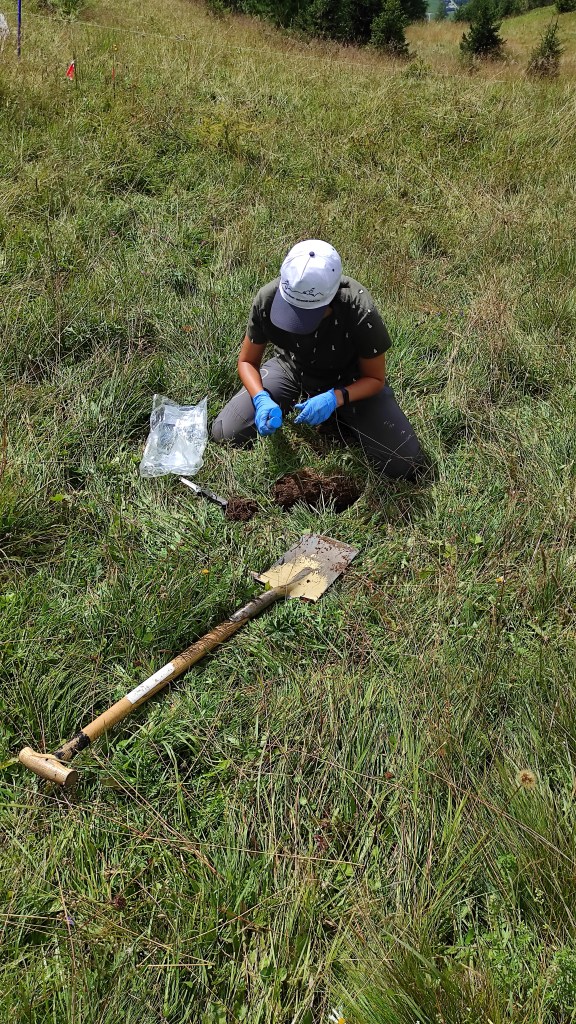
In a subalpine grassland in the Stubai Valley (Austria), we set up 30 10 × 10 m plots along two gradients of increasing shrub cover, one dominated by deciduous, the other by evergreen ericaceous dwarf shrubs. At peak biomass, we extracted soil monoliths beneath shrubs and grasses, washed roots, scanned them for morphology, profiled fungal partners with DNA sequencing, and quantified active arbuscular mycorrhiza under the microscope. The data collection went very well and, although we initially planned a heavier field campaign, we rescaled the design to balance sample size and effort. To avoid problems, we put a lot of effort into clear protocols, organization and meticulous labeling so every sample was correctly identified and everyone knew their role. This may seem obvious, but it was crucial with a large team and many samples. I cannot say enough how grateful I am to the fantastic team of collaborators and students who helped us keeping a high-quality work through sun, rain, and endless root washing. They made this work possible, but also much more fun.
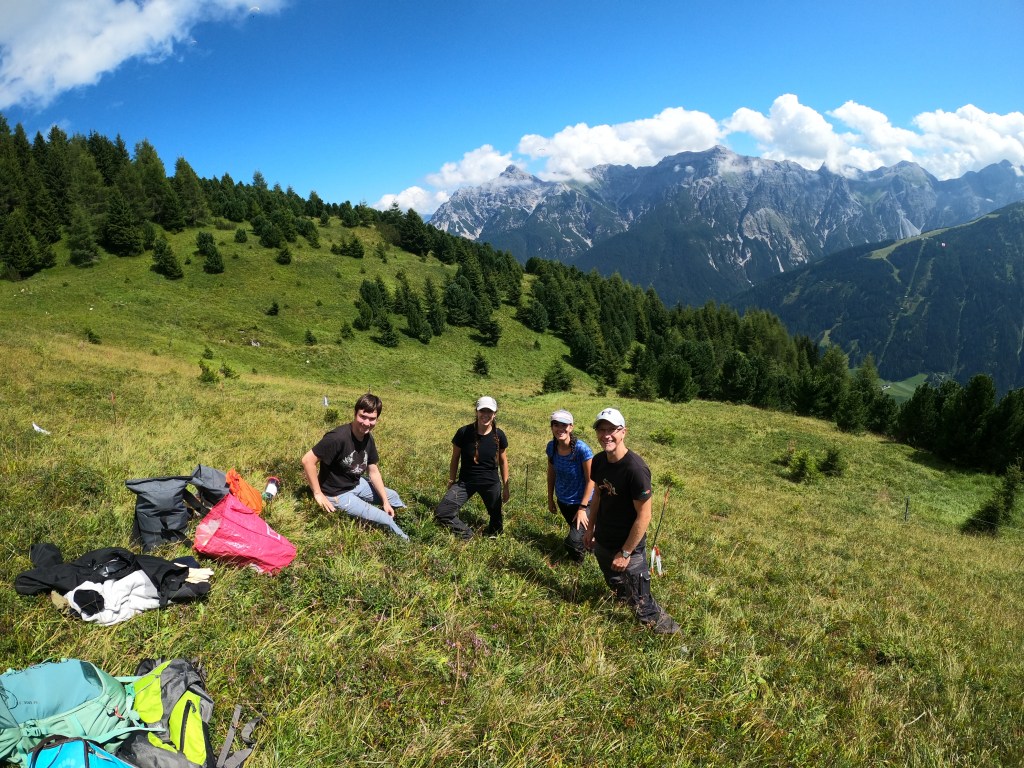
Two surprises stood out from our results, one more general at the project level and another one specific to this study. Project-wide, we expected to find tipping points with increasing shrub encroachment, but found mostly linear shifts on plant traits and nutrient content from herb- to shrub-dominated communities. In this paper, belowground community patterns contrasted with our expected results and the aboveground results from the same site, hinting at a decoupling of leaf and root strategies as shrubs advance. We also found that the interaction among root traits and mycorrhization at plant community level did not follow the framework established by the root economics space and it has been challenging to explain and understand some of the interactions observed due to the lack of literature. That is why I believe we need to better pin down the mechanisms linking root traits and mycorrhizal partners at the community scale through field studies across different ecosystems. On the applied side, practical studies for restoring or managing encroached grasslands are urgently needed in the Alps.
About the author
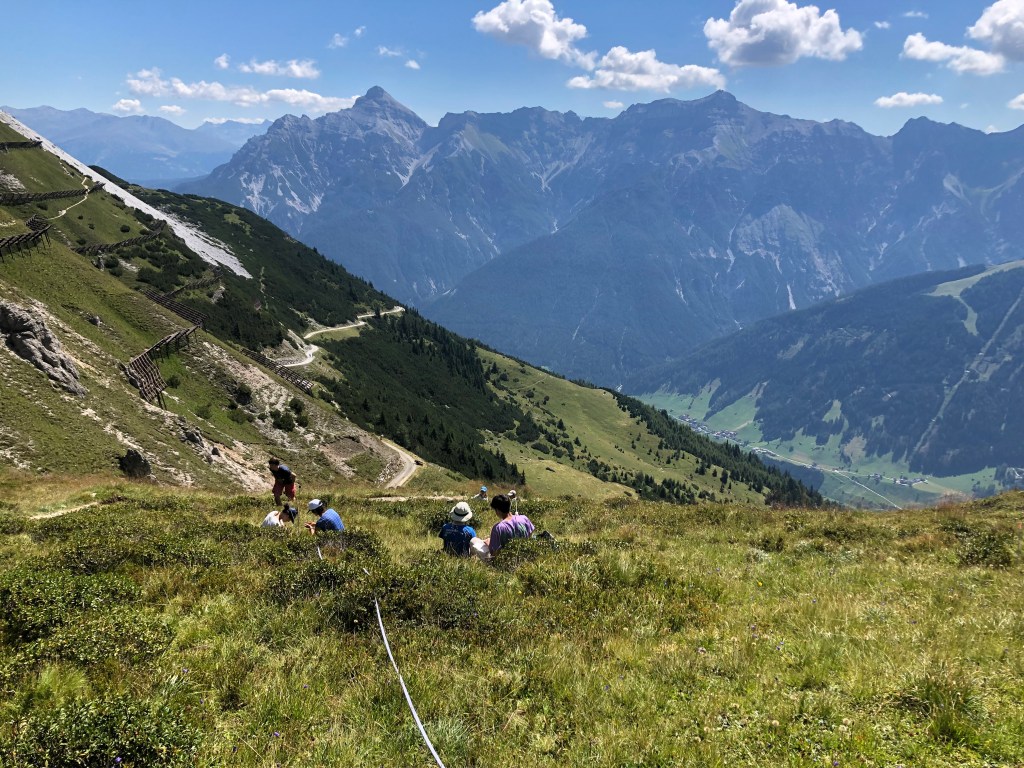
I am a postdoctoral researcher at the University of Innsbruck. Being in love with nature since early days led me to study Biology and then a master’s in Ecology, Conservation and Restoration. Two undergraduate internships drew me into ecology, and I fell in love with fieldwork and the chance to understand how nature works and its changes. Since then, I have focused my research on how climate and land‑use changes shape plant communities and plant–soil interactions. After preparing this paper, my main obsession is roots and their microbial partners, how above‑ and below‑ground traits connect, and when and why they couple or decouple. I am looking forward to keep working on these topics!
I work with an amazing and supportive team that helps me face the usual hurdles and fears of academia with good humor and hope. As a female early-career scientist, I am lucky to be surrounded by passionate, brilliant women at different career stages who remind me there is a place for us in science. If I could offer my younger self one piece of advice, it would be to listen to yourself and trust that you are braver than you think.