

Archaeologists have released images and new findings from the latest phase of underwater excavations at the historic shipwreck of the brig Mentor off the coast of Kythera.
The research campaign, carried out in 2025 by Greece’s Ephorate of Underwater Antiquities, continues efforts to study the vessel closely associated with the controversial removal of antiquities from the Acropolis of Athens in the early 19th century.
The Mentor, a privately owned ship belonging to Lord Elgin, sank in September 1802 near the port of Avlemonas on the southeastern coast of Kythera.
The vessel had been used to transport antiquities taken from Greece, including part of the sculptural decoration of the monuments of the Acropolis. It’s sinking scattered part of this cargo on the seabed, triggering early recovery attempts shortly after the accident.
The 2025 research season was directed by archaeologist Dr. Dimitris Kourkoumelis-Rodostamos, deputy head of the Ephorate of Underwater Antiquities.
According to a statement from the Ministry of Culture, this year’s systematic excavation focused on areas west and north of the surviving section of the ship’s hull. In the first excavation area, designated Section 1/2025, archaeologists explored a zone approximately five meters west of the preserved hull remains.
The aim was to determine whether additional structural elements of the vessel had survived. Excavation of the area reached a depth of about one metre beneath the seabed; however, researchers found no remains of the ship’s wooden structure.
A second excavation region, Section 2/2025, was conducted north of the surviving section of the ship’s keel to determine whether ship fragments had been carried in that direction as well. While no wooden planks from the vessel’s outer structure were found, archaeologists recovered objects related to the ship’s equipment and fragments of everyday utensils that the crew used.
One of the more interesting finds was copper plating from the ship’s exterior hull. Similar copper sheathing was also used to safeguard wooden ships from marine life and deterioration.
Evidence also suggests that the lower part of the hull, especially the keel, had been reinforced with lead sheets. During the excavation, a section showing the junction between copper and lead plating was identified.
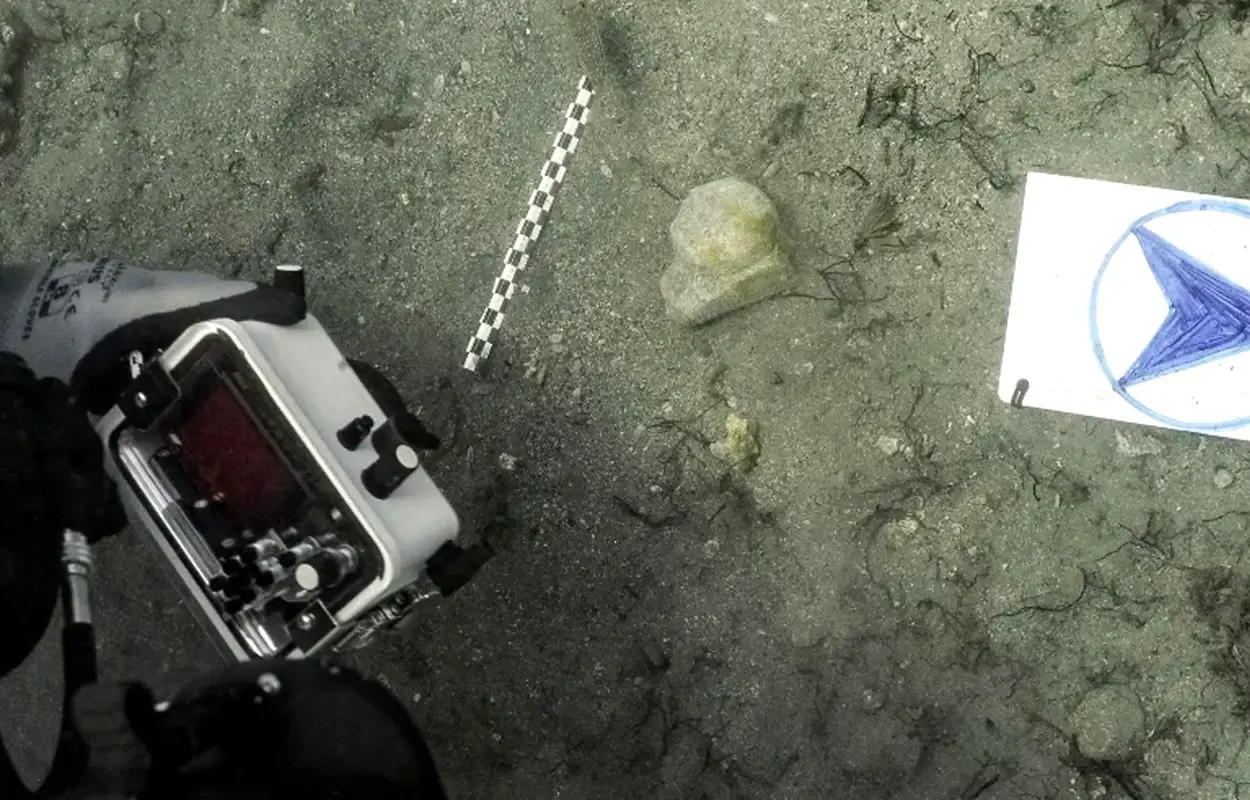
A small marble decorative fragment thought to belong to the ship’s original cargo had prominent significance. The piece was a few centimetres in size and features a carved decorative drop and may have been an architectural element, e.g., epistyle or cornice. The dimensions correspond to the decorative elements recorded on the Parthenon, the researchers write.
“The fragment has maximum dimensions of 9.3 cm. (length) x 4.7 cm. (width), and the drop has a diameter of 6.51 cm and a height of 2.2 cm. The dimensions of the drop can be compared with the measurements of A. Orlandos, regarding the decorative drops of the epistyle of the Parthenon,” said the Greek Ministry of Culture
It is the first time that a piece of sculptured architectural decoration was found in the remains of the Mentor’s cargo, much of which had come to light shortly after the shipwreck in the early 19th century.
Sources : Ministry of Culture