
Bad news for anyone counting on getting sharper with age: once a few statistical quirks are corrected, overall IQ most likely peaks in your thirties, not your seventies. That’s the case Adam Rochussen, a fellow at the Salk Institute for Biological Studies and the Roots of Progress Institute, makes in Aporia Magazine.
Rochussen is responding to Aaron Dymarskiy’s argument that longitudinal studies, which follow the same people for decades, show intelligence climbing into old age, to the point that the average 70-year-old outthinks the average 20-year-old. Rochussen isn’t buying it. “Sadly, the question is not if cognitive decline begins, but when,” he writes.
His first fix was to drop studies that began testing participants as children. Comparing scores at age 11 and age 80 mostly captures a brain finishing its development, not adult change. With those studies removed, the adult data put peak fluid intelligence, or raw problem-solving ability, around age 35.
Then there’s the practice effect: people do better on tests they’ve seen before. In one 2002 longitudinal analysis by McArdle and colleagues, “retesting boosted scores by an amount equivalent to 9 years of cognitive decline,” Rochussen notes. Adjust for that, and the model’s IQ peak falls to age 26. Healthier volunteers sticking around in long studies tilts the results further.
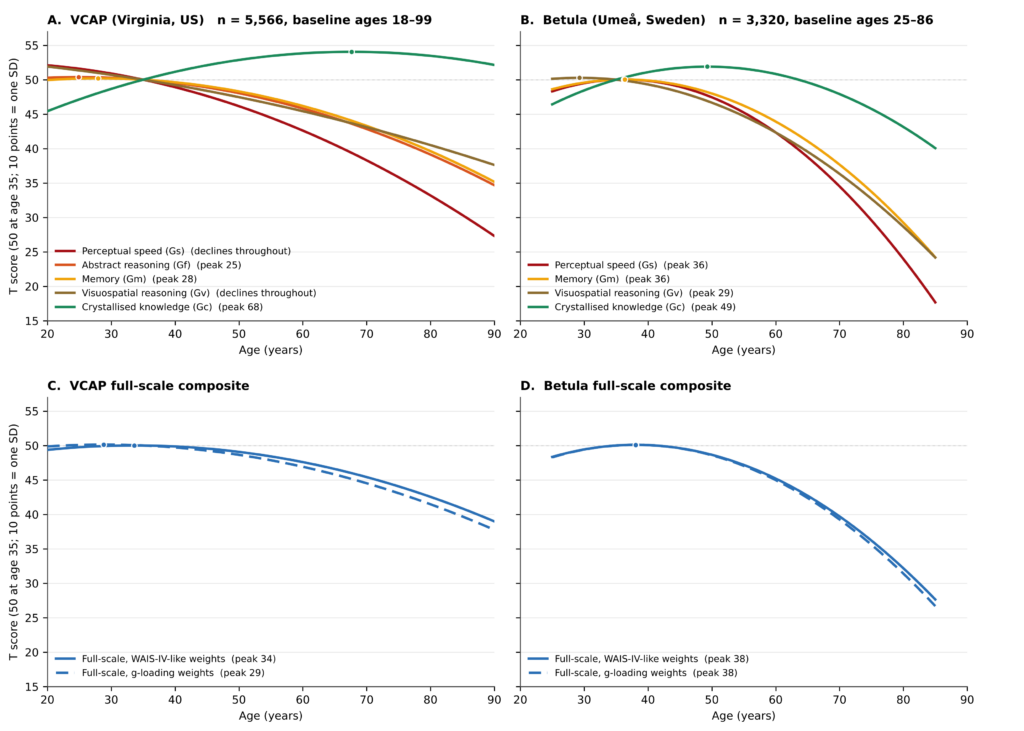
Crystallized intelligence, the store of accumulated knowledge, is the exception. It keeps rising, peaking at 49 in Swedish data and 68 in American data, according to growth curves published in Science Advances.
Rochussen acknowledges the caveats. Few studies feed the estimates, most of the data is old and Western, and today’s seniors may age better thanks to exercise and less drinking. Still, his bottom line is blunt: “And peak full-scale IQ probably occurs in the thirties.”