
If you follow the Trump administration’s social media posts, you might spot its new mascot: a cartoon lump of coal with big eyes and babylike features. “Coalie” sparked a backlash almost as soon as Interior Secretary Doug Burgum debuted it for the Office of Surface Mining and Reclamation Enforcement in early 2026.
Coalie’s design draws on a type of Japanese anime called Kawaii, a word meaning “cute” or “adorable.” It’s the latest in the White House’s efforts to pass off coal as harmless, despite the well-established environmental and human health harms of mining and burning the fossil fuel.
As a scholar of American literature and culture, I write about media portrayals of coal, beginning in the 19th century with its rise to become the leading fuel in the United States. Coal use grew until the early 2000s, when other sources became cheaper and its health and environmental damage became unacceptable to more of the public.
While “Coalie” might be new, the logic behind it is not. For centuries, coal’s promoters have worked hard to show coal as harmless – as well as “clean” and “beautiful,” to use President Donald Trump’s words.
‘An agreeable heat’
Humans living with the effects of burning coal have disliked it for as long as they have burned it.
In 1578, Queen Elizabeth complained that she was “greatly grieved and annoyed with [its] taste and smoke” in the air. In 1661, John Evelyne’s treatise Fumifugium outlined negative health effects of breathing coal smoke.
University of California San Diego Libraries/Wikimedia
English settlers were drawn to North America in part because of the continent’s abundant supply of timber, a substitute for coal that deforestation had made prohibitively expensive in England.
But by the 19th century, the price of timber had risen in America as well. When, in the 1820s, news spread of Pennsylvania’s rich veins of anthracite coal, urban consumers were eager for a cheaper source of fuel.
In addition to its lower price, anthracite coal grew desirable because of its high carbon, low-sulfur content, which produced less visible smoke when it was burned. An enthusiastic 1815 letter to the editor of the American Daily Advertiser captured increasingly common attitudes toward anthracite as “affor[ding] a very regular and agreeable heat.”
‘A healthful home’
The spread of anthracite also shored up tolerance for smokier but cheaper bituminous coal.
To help people, housekeeping manuals aimed at the fossil fuel’s mostly female users tried to invent workarounds for its smoke. In 1869, Harriet Beecher Stowe, best known as the author of “Uncle Tom’s Cabin,” and her sister Catharine Beecher wrote one of many 19th-century articles to acknowledge the “evils” of coal smoke, while outlining “modes of making a healthful home,” in the housekeeping manual American Woman’s Home.
Consumers provided temporary solutions for maintaining indoor air quality while burning coal by sending in suggestions that were published in housekeeping manuals, magazines and newspapers.
Nineteenth Century Newspapers
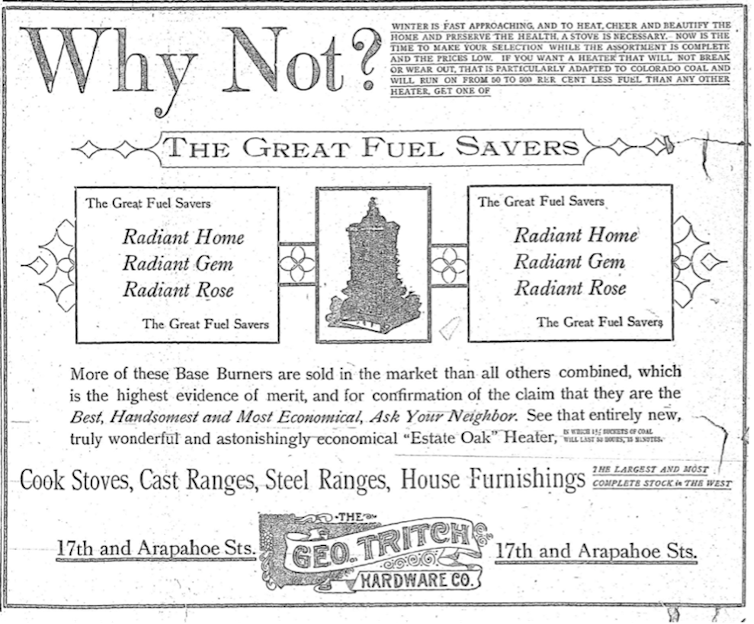
At the same time, as the century progressed, coal and coal-stove companies began to suggest that burning coal was healthy, that it could improve indoor air as well as domestic aesthetics. One 1892 newspaper advertisement claimed that stoves were “necessary to heat, cheer, and beautify the home and preserve its health.”
To keep the children clean and bright …
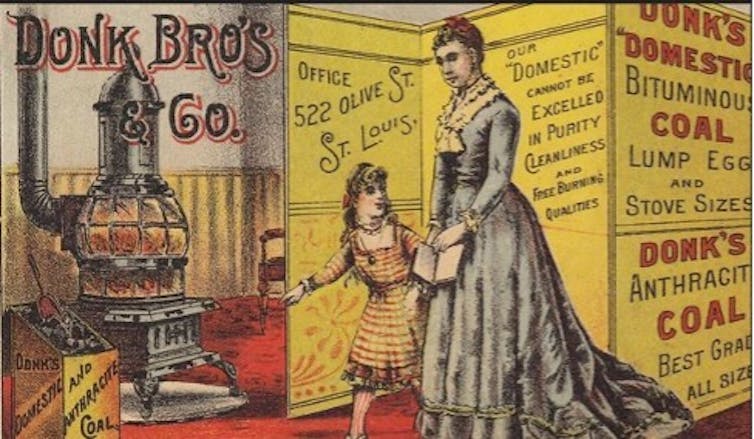
In the 20th century, marketers churned out more colorful claims about the benefits of coal: One magazine advertisement showed a mother and child pointing at the crackling stove aflame with the company’s coal, saying it “cannot be excelled in purity, cleanliness, and free-burning qualities.”
Madison Historical, CC BY-NC-SA
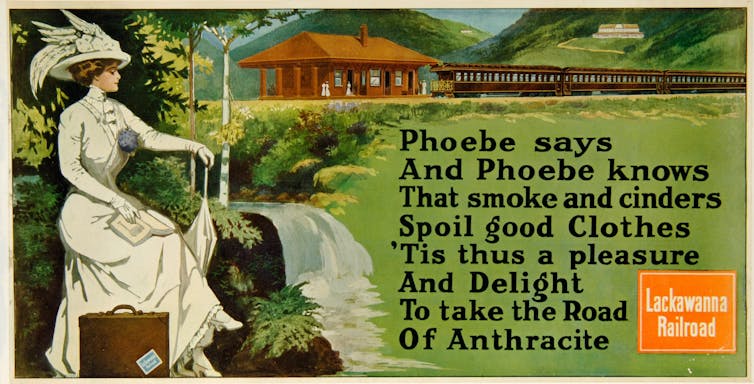
Similarly, the Lackawanna Railroad Company came up with the classy, often rhyming, character of Phoebe Snow. In one ad, she points to the importance of comfort, suggesting that not only could anthracite fuel faster travel, but it could also make your travel – and your life – more comfortable.
Railroad Museum of Pennsylvania/Wikimedia Commons
Coal marketing often used children to suggest safety and reach parents. Another iteration of the Phoebe Snow series promised that anthracite-powered railway travel could keep children “clean and bright.”
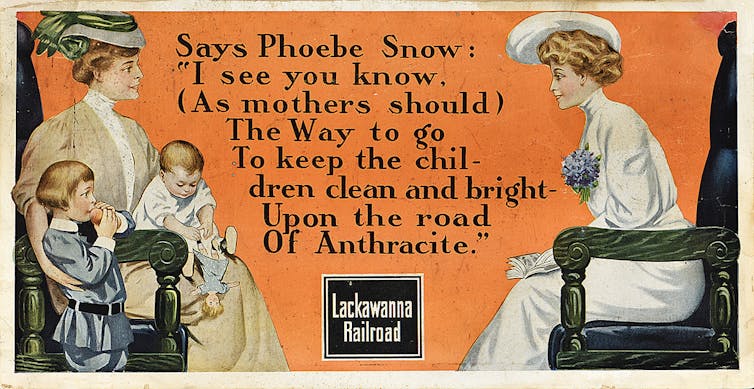
Photo Courtesy of Poster House/Poster House Permanent Collection
A 1930s advertisement went so far as to position a piece of anthracite coal next to a child in a bathtub, a visual proximity implying that coal was as good as soap.
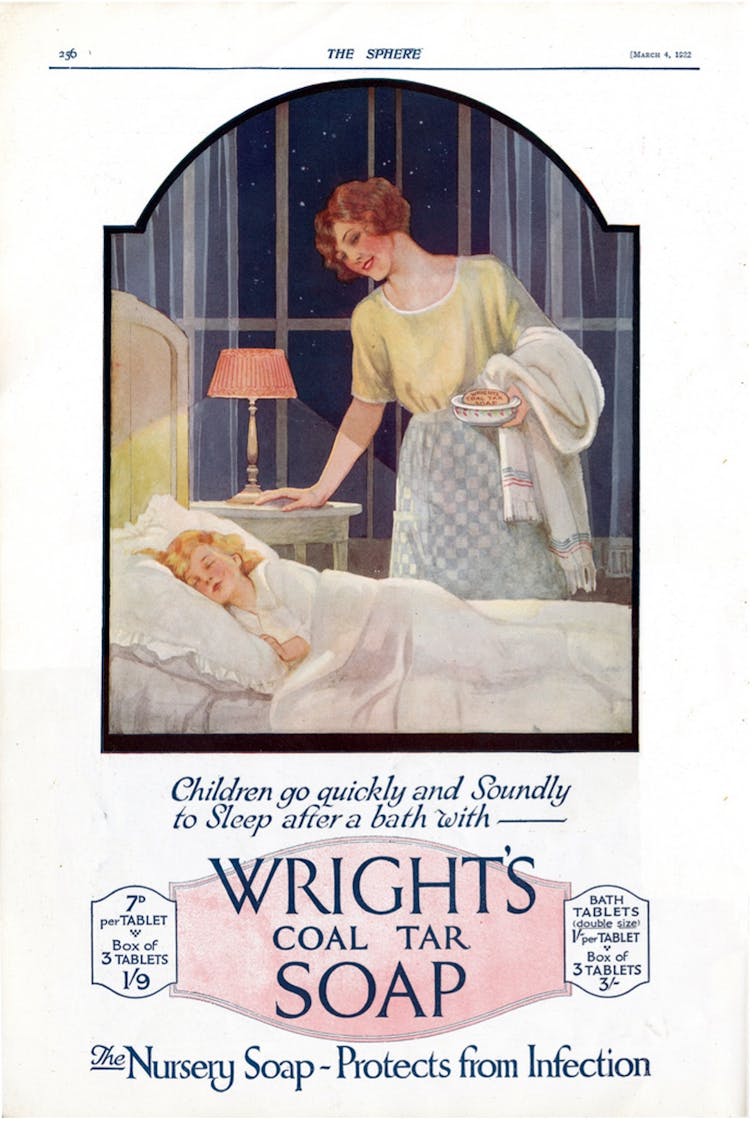
In fact, soap made of “coal tar” – a liquid byproduct of producing coke, a fuel made from bituminous coal used in industrial blast furnaces – did (and does) exist. The British company Wright’s, also popular in the U.S., generated a slew of advertisements praising its soap as having antiseptic properties for children.
Wikimedia Commons
Each of these advertisements tried to capitalize on a mother’s desire for healthy children. And they pushed back against the image of the tyrannical “King Coal” that had come about amid strikes by miners protesting dangerous, degraded working and living conditions as well as the rise of black lung disease.
‘Clean coal’
By the mid-20th century, petroleum took coal’s place as America’s main energy source. The U.S. environmental movement continued to grow, and people got interested in natural gas as an alternative to coal.
In response, coal companies doubled down on the fantasy of “clean” coal.
Wall Street Journal archive
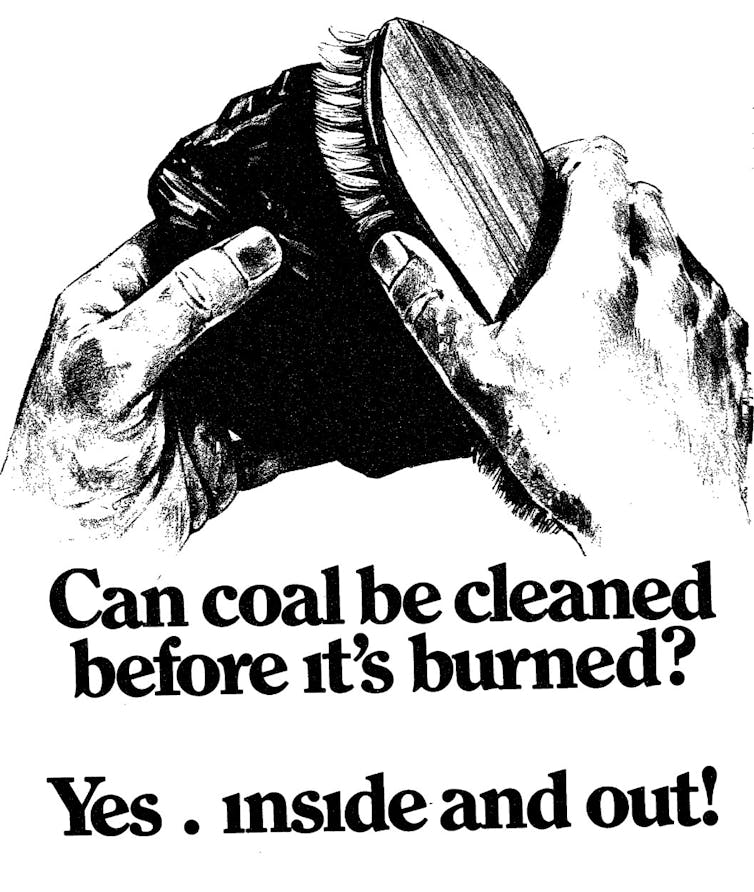
A 1979 advertisement for American Electric Power, for example, flew in the face of Clean Air Act mandates that coal corporations employ “scrubbing” technology to remove sulfur dioxide from smoke – the ad depicted someone cleaning coal by hand.
The myth continues
Today, coal generates only 16.2% of America’s electricity, down from generating more than half of the U.S. power supply in the 1990s. But the country isn’t done with it. Even though coal production today is far below its peak, as companies try to shut down old uneconomic plants, Trump has promised to “reinvigorate” the coal industry.
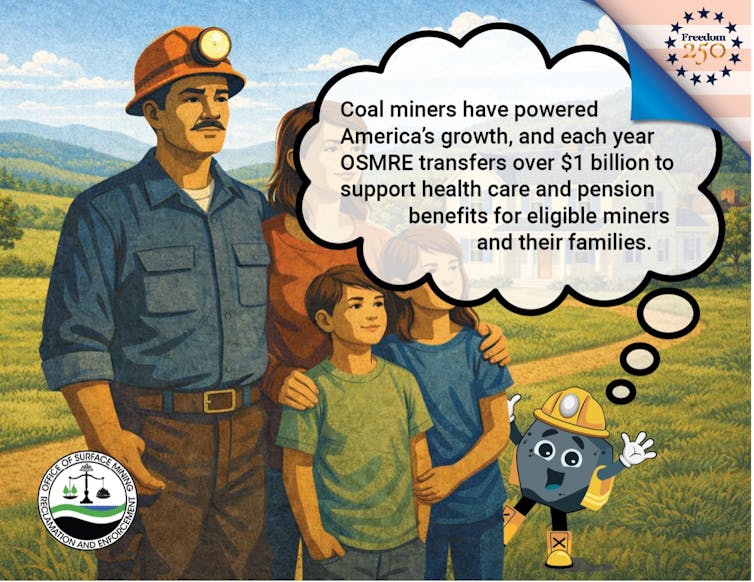
In addition to ordering some coal plants to continue operating, the Trump administration has pulled out old coal promotion tactics from the past, including repeatedly referring to coal as “clean and beautiful.” One image inserts Coalie next to a coal-mining family that otherwise looks like an ad that could have appeared a century ago.
OSMRE
And, like its predecessors, this picture tries to present an innocent image of a product that harms human health and the environment.
A 2018 study found that black lung disease was on the rise in Appalachia, where about 40% of America’s coal is mined today. Living near a fossil-fuel power plant exposes residents to pollutants that contribute to premature deaths, asthma and lung cancer, including tiny particulate matter known at PM 2.5, sulfur dioxide and mercury. Even when it’s just sitting in piles waiting to be used at a power plant, coal can harm human health as the wind blows across it and carries coal dust into the air and people’s lungs.
The myth of coal as healthy and family friendly has been around for centuries – but coal has never been clean, or cute.