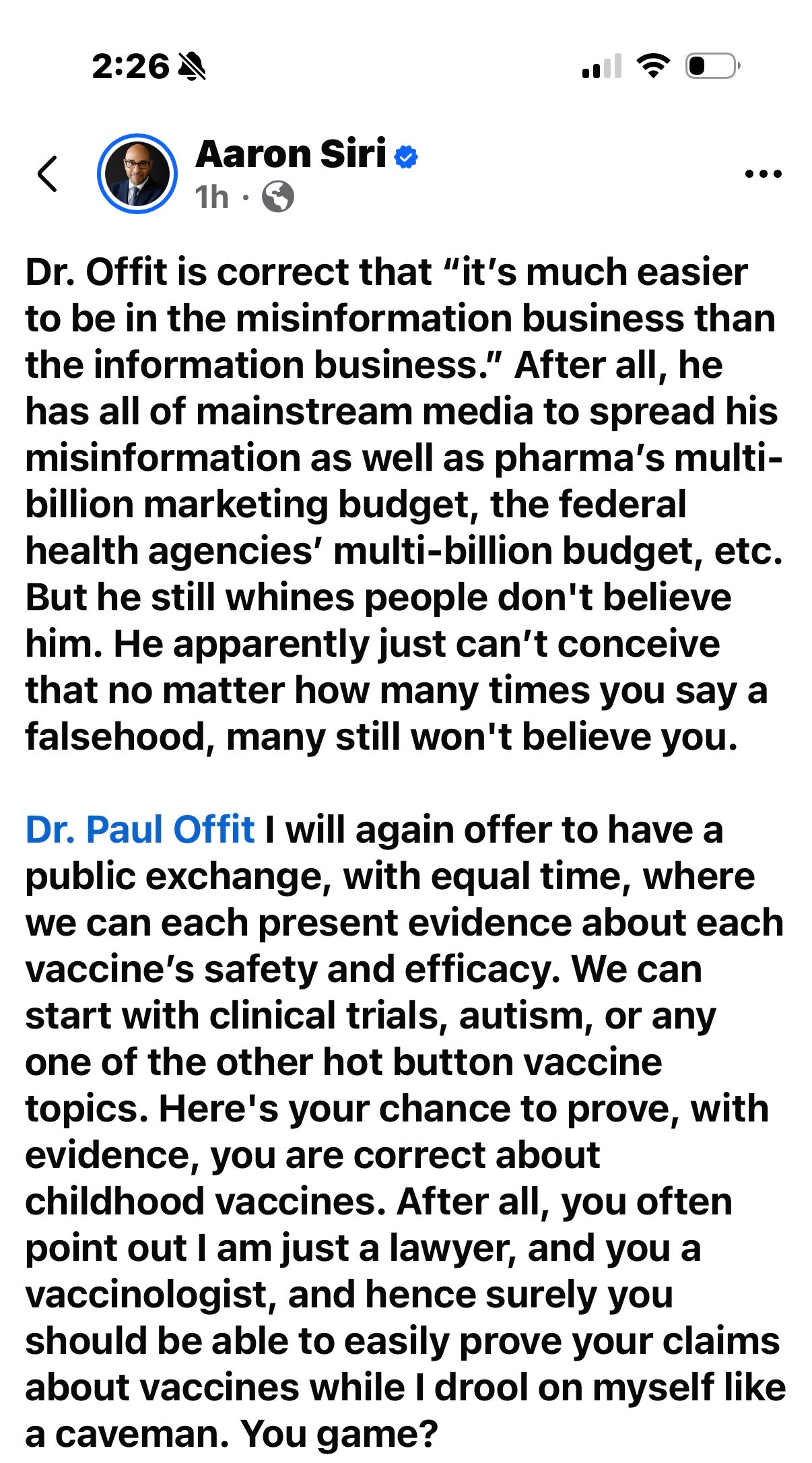
Several years ago, people representing RFK Jr., who at the time was head of the anti-vaccine group, Children’s Health Defense, offered me $50,000 to debate him about the safety of vaccines. In the past week, Aaron Siri, a personal-injury lawyer whose firm represents an anti-vaccine group called Informed Consent Action Network, also asked me to debate him. As did Steve Kirsch, an entrepreneur and co-inventor of the optical mouse, who offered me $1 million if I agreed. I turned them all down because it doesn’t matter what they say during the debate. And it doesn’t matter what I say. The only thing that matters is the strength and reproducibility of the evidence.
Here is how to resolve vaccine safety issues:
- In 1976, a vaccine to prevent a swine flu pandemic was shown to be a rare cause of Guillain-Barré syndrome, an ascending form of paralysis. Researchers submitted their findings to the New England Journal of Medicine, one of the world’s premier medical journals, where subject matter experts reviewed the evidence and agreed that the data supported the conclusions. This observation was replicated by other investigators.
- In 1998, a rotavirus vaccine called RotaShield was shown to be a rare cause of a severe intestinal blockage called intussusception. Researchers submitted their data to the New England Journal of Medicine, where it was reviewed by subject matter experts who agreed that the data supported the conclusions. Again, this vaccine safety issue was confirmed by other investigators. Ten months after its introduction, RotaShield was taken off the market.
- In 2010, researchers found that a swine flu (H1N1) vaccine used in Europe called Pandemrix caused narcolepsy, a permanent disorder of wakefulness. They submitted their findings to the journal, Vaccine, whose reviewers agreed that Pandemrix increased the risk of narcolepsy in Sweden. Further studies outlined a biological mechanism for how it could have happened. Pandemrix was eventually taken off the market.
- In 2021, Johnson & Johnson’s Covid-19 vaccine was found to be a rare cause of clotting, including clotting of the brain, which could be fatal. Researchers submitted their data to the New England Journal of Medicine where, again, reviewers agreed with the study’s conclusions. By May 2023, J&J’s Covid-19 vaccine was taken off the market.
Robert F. Kennedy Jr. believes that vaccines cause autism. On January 30, 2025, during a confirmation hearing before the Senate Help, Education, Labor, and Pension (HELP) committee, Kennedy held up a paper that he believed proved his point. “This,” claimed RFK Jr., “is gold-standard science.” RFK Jr.’s study claimed that vaccinated children in a Florida Medicaid program had significantly higher rates of neurodevelopmental disorders, including autism. The paper was never published in a scientific or medical journal, was funded by an anti-vaccine group, and appeared in a Word Press Blog where it was “reviewed” by anti-vaccine activists. The reason the study was never published was that it was methodologically uninterpretable, failing to account for family history of neurodevelopmental problems, socioeconomic factors, environmental exposures, and, most importantly, the fact that the diagnosis of autism had changed. Worse, you couldn’t tell who had been vaccinated and who hadn’t. RFK Jr. argued that the reason that his “study” wasn’t published was because of a conspiracy by Big Pharma and government agencies to hide the truth. But RFK Jr. had no truth to tell.
Like RFK Jr., Aaron Siri tried to make his case against vaccines in a congressional hearing instead of the cauldron of peer review by medical journals. On September 9, 2025, in front of a Senate subcommittee, Siri said that a study showed that vaccines were causing a host of chronic conditions. The study, launched at the behest of Siri’s anti-vaccine group, Informed Consent Action Network, was performed by researchers at Henry Ford Health in Detroit. Like RFK Jr.’s study, this study was never published and never peer reviewed. Siri knew why. The findings were “shoved in a drawer,” he claimed, because the authors feared they would lose their jobs if they bucked a medical establishment that defended vaccines at any cost. This, according to Siri, was a “real world example of how science gets corrupted” by undue influences such as peer pressure and Big Pharma. Officials at Henry Ford Health, however, disagreed, writing they had “not published [the paper] because it did not even come close to meeting the rigorous scientific standards we demand—not because of the results.” No conspiracy. No cover-up. Just bad data.
Enter Steve Kirsch, who has said that Pfizer’s Covid-19 vaccine has “killed more people than it saved.” Great. Prove it. Do the kinds of epidemiological studies that were done for Guillain-Barré syndrome, intussusception, narcolepsy, and clotting. Do the hard work that’s required to prove that a vaccine safety problem is real and stop whining about Big Pharma and government conspiracies. Serious vaccine safety problems will be published if the data are rigorously collected, analyzed, controlled for confounding variables, subjected to peer review, and reproduced by other investigators. And they won’t be published if the data are weak. Vaccine safety is a scientific question that should be solved in a scientific venue, not on a debate stage.
Paul Offit is a professor of pediatrics at the Children’s Hospital of Philadelphia, co-inventor of a rotavirus vaccine, and author of Tell Me When It’s Over. Find Paul on X @DrPaulOffit
A version of this article was originally posted at Beyond the Noise and is reposted here with permission. Any reposting should credit both the GLP and original article. Find Beyond the Noise on Substack