
In this blog post, author Bálint Üveges discusses the paper “No gain from pain: Lack of nociceptor activation suggests no adaptation for defence in the evolution of European viper venoms“, which was published in Functional Ecology in August 2026. Bálint discusses the intensive fieldwork behind this research, testing if the venoms of Eurasian vipers evolved for a predatory or a defensive function and whether causing pain is their primary function!
As long as I can remember, I wanted to be a biologist working with animals. Early during the university, I became fascinated with reptiles and amphibians, especially the poisonous and venomous kinds. Then, after finishing my PhD, in 2020 I pitched an idea to Dr. Wolfgang Wüster, world-renowned herpetologist at Bangor University, Wales, about studying the evolutionary ecology of venoms in meadow vipers (Vipera ursinii), one of the lesser-known venomous snakes of Europe. We were fortunate enough that this idea got funded by a Leverhulme Trust Research Project Grant. What followed were three years of intensive fieldwork during which we visited the diverse and often isolated populations of the meadow viper and species. For example, we visited the remnants of the historically vast steppes in Ukraine, the sandy shores of the Black Sea in the Danube Delta, or the scenic peaks of the Dinaric Alps and Apennines in the Balkans and Italy, respectively. During these expeditions we usually camped out in the wild and collected venoms and genetic material of the animals.
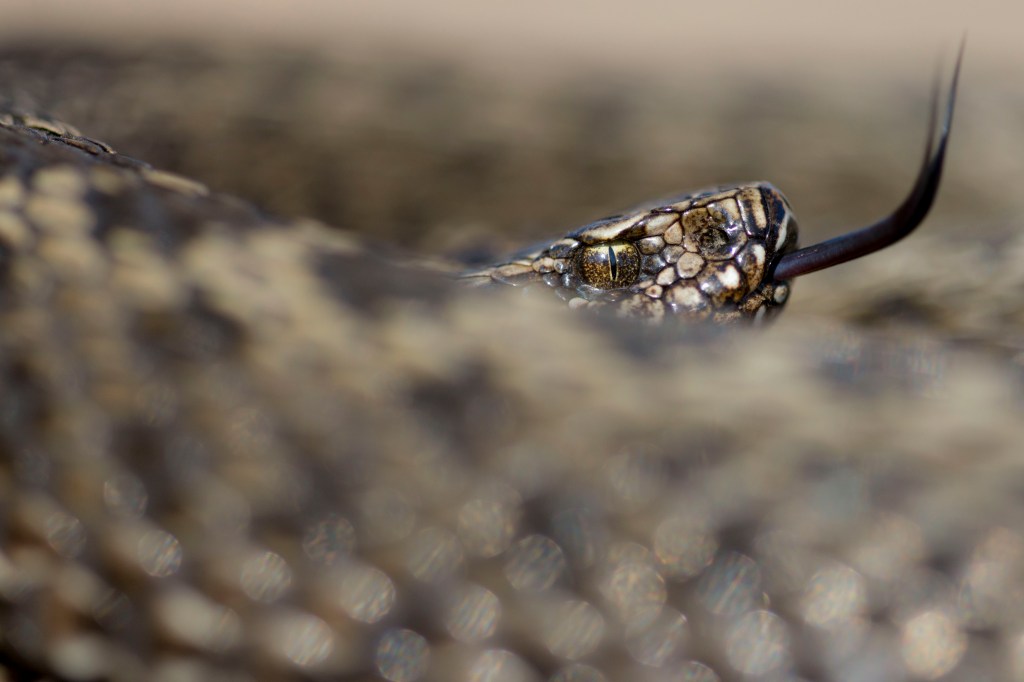
Our new paper published in Functional Ecology is the first publication of this project, in which we asked the questions if the venoms of meadow vipers were adapted to a defensive function and if there is a trade-off between evolving venoms for prey capture vs. defence against predators. You see, different venom functions require different toxins: in case of predatory venoms, the toxins need to rapidly immobilise prey by affecting a multitude of vital physiological processes (e.g. by disrupting neuromuscular connections, blood clotting or muscle integrity), whereas defensive toxins have one main role only: to cause rapid, intense pain to deter predators (think of a bee sting for example). This latter effect is achieved by toxins directly affecting nociceptive (i.e. pain-sensing) receptors on sensory neuron cells in the peripheral nervous system.
This functional difference coupled with the likely energetically costly nature of venom toxins lends itself to a potential trade-off between the production of predatory vs. defensive venoms. It has been shown that snake venom evolved mainly for a predatory function, but it is also common knowledge that they use their venom defensively against their own predators and humans. However, the role of self-defence in the evolution of their venom is lesser known, apart from the unique case of spitting cobras, and even though the snakes themselves often fall prey to various other predators. There is a problem though: how does a venomous snake capture prey if its venom is adapted to defence and it is not suitable to overcome its quarry? This might not work in cases where the snake needs to wrestle an animal that can effectively fight back, such as many rodents, but there might be species which are more easily handled and might not need a very effective venom, such as certain frogs or insects. So, our hypothesis was that in case of species that feed on prey that are easily overcome, selection for highly effective predatory venoms might be relaxed and there might be room for more defensive toxins instead.
The curious thing about meadow vipers, which also makes them ideal model species to test our ideas, is that most of their populations eat mainly orthopterans (grasshoppers, crickets and locusts); in some cases, like the Greek meadow viper (V. graeca) these are essentially their only food. Talk about a strict diet! However, there are some subspecies, as well as closely species (like the steppe viper, V. renardi, the adder, V. berus, the asp viper, V. aspis, or the nose-horned viper, V. ammodytes) which also, or mostly eat well-defended vertebrates, such as rodents and lizards, for which they might need a more effective predatory venom. This means that by comparing the venoms from different (sub)species we can test if their venoms evolved for a predatory or a defensive function.

We did this by conducting laboratory assays on sensory neuron cells: we added the venoms to the cell cultures and measured their effect on said cells, which were treated with a fluorescent dye beforehand. Essentially what happens if a nociceptor reacts to a venom toxin is that calcium ions from outside of the cell migrate into the cell. Here they react with the dye that was picked up by the cells previously and this leads to an increase in emitted fluorescence, which can be detected by specialised instruments. So, in case of a defensive and thus pain-inducing venom we would expect to see a rapid jump in fluorescence. To our surprise, these tests showed that, no matter the diet of the snakes, the venom of European vipers uniformly refused to activate the nociceptors of these cells (bummer!). This means that it is more likely that, like in many other snake lineages, these venoms evolved for overcoming prey, instead of defending the snake against predation.
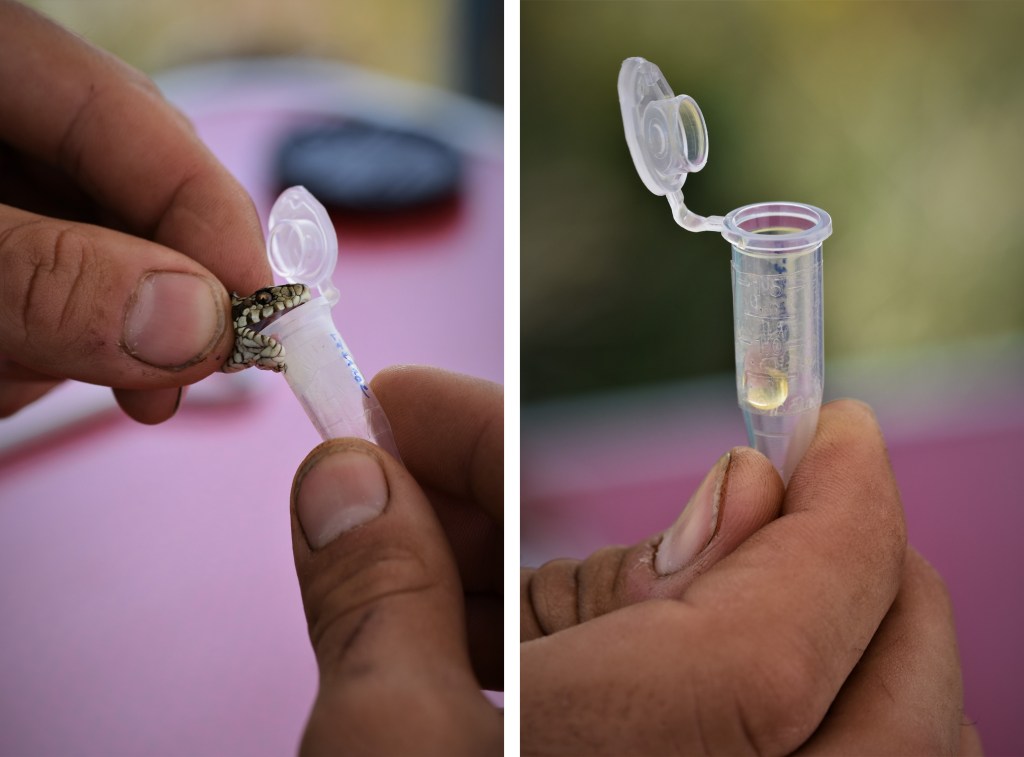
Curiously though, bites of the species used in our study are still frequently considered to be very painful. How can this be? First of all, pain is a very subjective sensation, depending on e.g. the physiological or psychological state of the victim, be it humans or other animals. Even the same venom shot could potentially cause very different pain reactions in different individuals. Second, venom is a complex cocktail of different toxins that affect a multitude of biological processes and is by definition harmful for the victim, so it is perhaps not surprising that the combined effect of these compounds might involve pain, even if this is not their primary function. This is mostly a consequence of the byproducts of envenomation symptoms such as inflammation, oedemas or tissue degradation. Secondary pain is also evidenced by clinical case reports showing that pain caused by snake venoms frequently arises later on (after several minutes or hours) and not right after the envenomation, and the secondary pain caused by meadow viper venom being more painful than the initial bite. We also note in our paper that it is possible that some populations or individuals of European vipers have directly pain-inducing venom components which we missed, but the general knowledge about snake venoms and the fact that we sampled multiple species throughout a huge geographical area makes this unlikely.
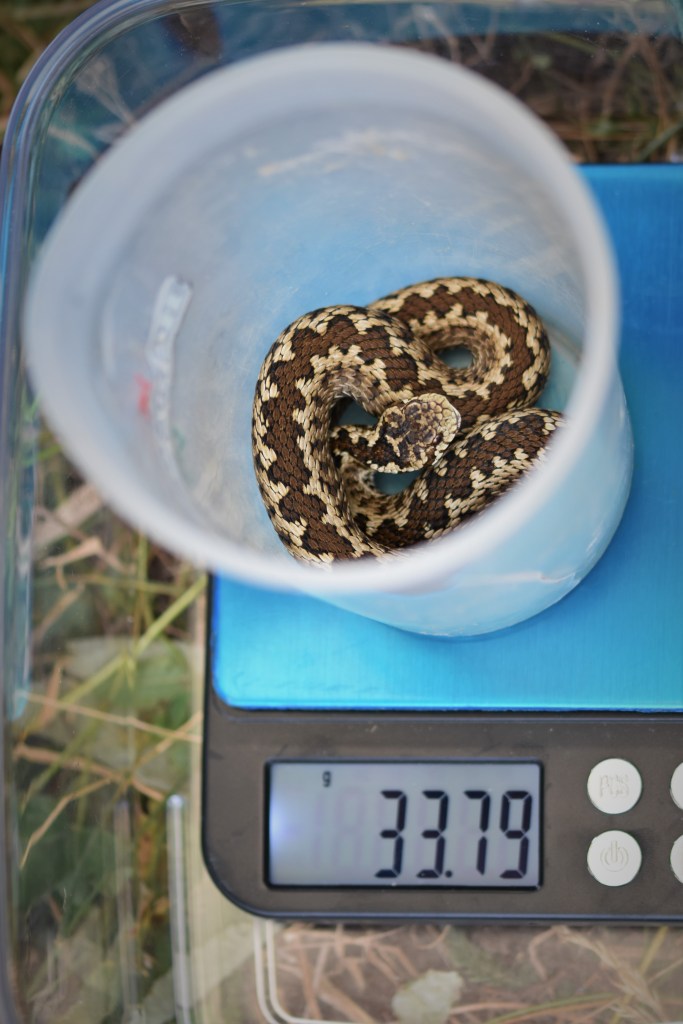
All in all, it seems that European viper venoms evolved similarly to other snakes to achieve a predatory function instead of self-defence, and so we also did not find a trade-off between the production of functionally different venoms. There is still a lot to discover about these amazing species and their venoms though!
