
In this blog post, author Li Zhang – a an Associate Professor at Nanjing Forestry University – discusses the paper “Nitrogen fertilization promotes wheat–weed coexistence through niche differentiation and fitness equalization”, which was recently published in Functional Ecology. Li applies modern coexistence theory to wheat and two dominant grass weeds, showing that nitrogen can promote coexistence through different mechanisms depending on the weed species. Li also shares the practical work behind the paper, and reflections on collaboration and balance when building an early-career research path.
About the paper
Species coexistence is one of the central questions in community ecology: why do some species persist together, while others exclude one another? As a master’s student, I worked with my supervisor, Professor Xingliang Xu, using 15N-labelled ammonium, nitrate, and glycine tracers to examine whether coexisting plant species could reduce competition through differential uptake of nitrogen forms. Although the idea was intuitive, our experiments suggested that coexisting species often showed similar preferences across these nitrogen forms rather than clear nitrogen-form partitioning. This highlighted the limited generality of resource-niche differentiation alone and motivated my interest in modern coexistence theory, a broader quantitative framework that evaluates whether stabilising niche differences are sufficient to counterbalance fitness differences in determining species coexistence.
In this paper, we applied this framework to an agricultural system: wheat and weeds. Nitrogen fertilization is widely used to increase crop yields, but it can also alter crop–weed competition and influence agricultural production and biodiversity. Weeds are often regarded as yield-reducing competitors, and this concern is valid. Yet plant diversity in agroecosystems may also support ecosystem functioning, including resistance to pests and pathogens. Nitrogen inputs can threaten biodiversity in both natural and managed ecosystems, including weed diversity in wheat fields.
We examined competition between wheat and two common grass weeds, wild oat (Avena fatua L.) and barnyard grass (Echinochloa crus-galli (L.) P. Beauv.), under ambient nitrogen and nitrogen-addition conditions. Nitrogen promoted coexistence in both wheat–weed pairs, but through contrasting mechanisms. With barnyard grass, nitrogen increased wheat root length and root area, widening belowground trait differences and weakening interspecific competition. This increased niche differentiation without significantly reducing wheat seed mass. With wild oat, nitrogen increased wild oat seed mass and root traits while reducing wheat height, narrowing fitness differences by weakening wheat’s competitive advantage and reducing wheat grain yield.
More broadly, our findings suggest that nitrogen addition does not simply determine which species win or lose; it can reshape coexistence by altering functional traits and the balance between niche and fitness differences. As human activities increasingly reshape environmental conditions worldwide, this mechanism-based perspective may help explain why biodiversity responses to anthropogenic change vary across ecosystems, and why coexistence can have different consequences for ecosystem functioning.
About the research
In 2021, at the Hefei High-Tech Agricultural Park of Anhui Agricultural University, we conducted a response-surface competition experiment that varied both total plant density and the relative proportions of wheat and weeds. We carefully transplanted seedlings, monitored survival throughout the eight-month experiment, and bagged inflorescences before seed maturation to minimize seed loss. At harvest, we collected data on seed mass and above- and belowground functional traits, including plant height, leaf traits, root length, root area, and root volume. Together, these measurements enabled us to link competitive outcomes with potential functional mechanisms.
This large experiment was made possible by the participation of undergraduate students including Junjie Gao and Shushi Cheng, with Master student Yizhong Rong taking a leading role in coordinating and conducting the experiment. Their involvement was supported by Professor Zhen Zhang, Dean of the College of Resources and Environment at Anhui Agricultural University, who strongly encourages undergraduate research training. Their contributions not only made the work feasible, but also gave students the opportunity to see how an ecological question develops into an experiment, a dataset, and eventually a paper. We also benefited greatly from Dr. Shengman Lyu’s expertise, including insightful discussions on coexistence theory, detailed feedback on the manuscript, and guidance in bringing the paper to its final form.
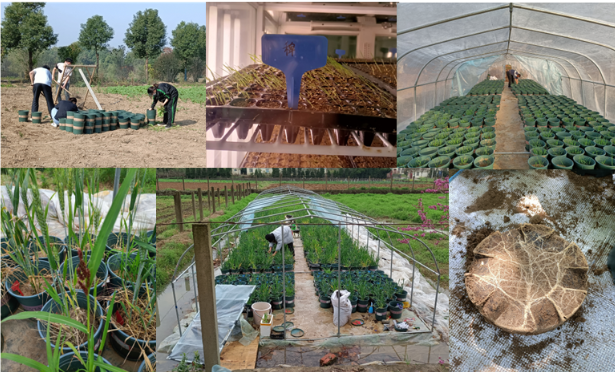
During sample collection, we noticed something that made us especially curious: nitrogen fertilization appeared to increase wheat seed mass when wheat grew with barnyard grass, but to decrease it when wheat grew with wild oat. This contrast led us to ask how nitrogen fertilization influences the mechanisms of coexistence in these two wheat–weed pairs. As our results showed, it did, but through different mechanisms in each pair. A key next step will be to determine whether plasticity in plant functional traits is adaptive or maladaptive under different competitive and nitrogen environments.
About the author
I am currently an Associate Professor at Nanjing Forestry University, where I am gradually developing my research direction in a new academic setting. My interest in ecology began during a two-week field course in my third undergraduate year at Lanzhou University, which took us to the Minqin Desert and Xiama Forest Farm for field visits and lectures. Experiencing these contrasting landscapes firsthand, while learning how ecologists observe and interpret them, made me curious about why species occur where they do and how organisms interact with their environments.
My current scientific obsession is bamboo ecology. Like wheat fields, bamboo ecosystems are also shaped by long-term interactions among plants, cultivation, harvesting, and management. Yet bamboo presents a very different ecological puzzle. It is an unusual “woody grass” or “grassy tree”: although taxonomically a grass, it can form forest-like stands and, in some species, grow by up to 140 cm in a single day. These distinctive traits, together with its capacity for rapid expansion, make me curious about bamboo’s role in biodiversity conservation, especially how it coexists with trees and understorey plants, and how its expansion reshapes forest biodiversity and ecosystem functioning.

As an early-career researcher, I am balancing limited funding with the many responsibilities of developing ideas, designing experiments, analyzing data, writing papers, teaching, and helping students develop their skills, confidence, and independence. I am also preparing to become a mother of two, which has meant making less time for some of the things I enjoy, such as hiking and watching dramas. Fortunately, I have not faced these challenges alone. Xiang, Xingliang, Ghassem, and many other senior colleagues, collaborators, and friends have generously offered advice, stimulating discussions, encouragement, and kindness along the way. If I could offer one piece of advice to my younger self, it would be this: do not feel that you need to solve every problem alone. Asking for help and becoming part of a supportive scientific community are essential to becoming a better scientist and colleague.