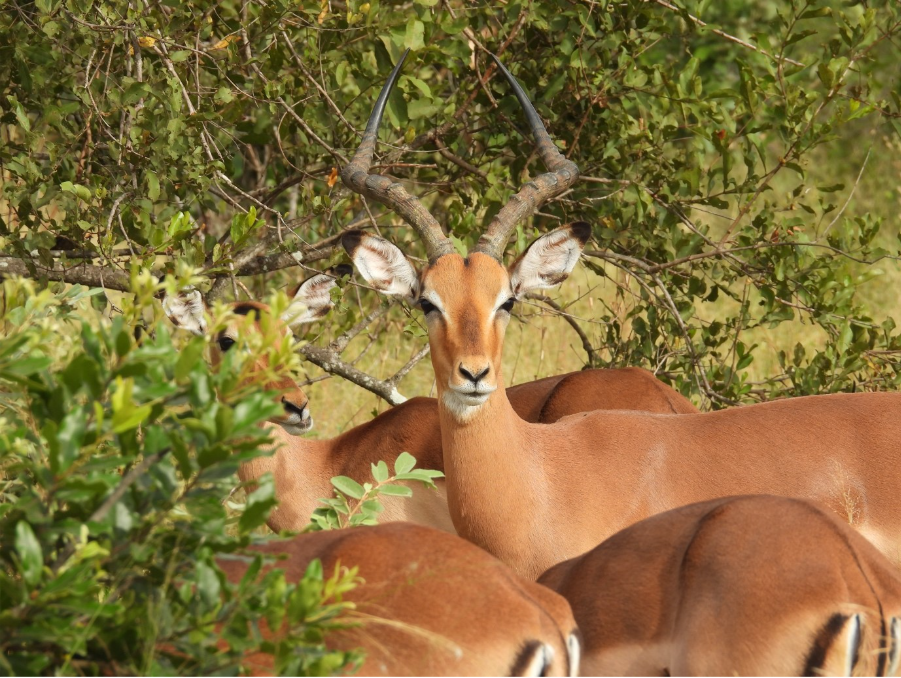
In this behind the Paper blog post, author Jonas Trepel – a postdoctoral researcher at Aarhus University – delves into the world of ecosystems engineers and discusses his paper “Wild large herbivores promote plant diversity and functional redundancy by reducing dominance“, which was recently published in Functional Ecology. Jonas shares the role of large herbivores as key ecological players, the thorny side of fieldwork, and the importance of doing work that truly interests you.
Bluesky: https://bsky.app/profile/jonastrepel.bsky.social
About the paper
Large herbivores are not only impressive (and fun) to look at, but also quite impactful ecosystem engineers. Because they spend most of their time eating and trampling, it is probably not a stretch to assume that they substantially modify plant communities – and there is plenty of evidence showing that they actually do that.

Interestingly, though, in a recent meta-analysis we found something that initially felt a bit suspicious: across studies, the overall effect of large herbivores on plant diversity was basically neutral. Some studies showed positive effects, others negative effects, and some no effect at all. That made us wonder what was going on, and we figured that a likely explanation for this apparent neutrality is that our meta-analysis dataset was, after all, a very mixed bag, with studies differing in herbivore species composition, exclusion duration, ecosystem type, treatment duration, and methods.
To get a better understanding of large-herbivore effects on plant diversity, we therefore thought it was necessary to focus on places where herbivore communities are still largely complete and treatment durations are long. And where better to find such places than South Africa? We worked across six long-term herbivore exclosure experiments in South Africa, spanning 21-71 years of herbivore exclusion and covering both savanna and Albany thicket ecosystems. Importantly, these reserves still contain nearly intact large-herbivore communities, including elephants, giraffes, and rhinos.
Our main finding was pretty consistent across our four savanna sites: large herbivores promoted herbaceous plant diversity by reducing the dominance of highly abundant species, especially grasses. In doing so, herbivores appeared to prevent dominant plants from completely taking over, allowing more species to coexist. We also found that herbivores increased functional redundancy, meaning that ecosystems with herbivores contained more species overlapping in trait space, which could potentially make these systems more resilient to future disturbances.
More broadly, our work highlights that large herbivores are not just charismatic animals; they are key ecological players. Yet humans made sure that most ecosystems worldwide have lost much of their large-herbivore communities over the last 5000-50000, which likely altered the way these ecosystems function and look like dramatically. Understanding what happens when herbivores disappear is therefore critical if we want to understand how ecosystems function and how resilient they may be in the future.
About the research

To study herbivore impacts, we collected data inside and outside long-term herbivore exclosures across South Africa. These exclosures are fenced areas where large herbivores have been excluded for decades, effectively allowing us to compare vegetation with and without herbivores under otherwise similar environmental conditions. Across all sites, we recorded plant community composition, vegetation structure, and several functional traits linked to plant strategies and responses to disturbance.
Fieldwork was both fantastic and slightly chaotic. We had to sample a rather large number of plots within roughly two months, before the growing season ended and many herbaceous plants became much harder to identify or disappeared entirely. Two things in particular did not help. First, thicket vegetation without large herbivores (i.e., inside the exclosures) is actually really thick (and thorny!). More often than not, it became quite difficult to move through, which substantially slowed us down. Second, our sampling period coincided with heavy rainfall at some sites, making them very difficult to access, and there were definitely moments when we wondered whether we would make it to all plots in time. Fortunately, we had incredible support from local collaborators, reserve staff, and field assistants who helped us navigate muddy roads, changing conditions, and complicated logistics. In the end, a great team and a bit of luck got us through just in time.
One thing that genuinely surprised me was how closely the experimental results matched findings from a correlative landscape-scale study we had conducted the year before in another region of South Africa. Despite using a very different approach (comparing 10 reserves with different large herbivore communties), we found essentially the same pattern: ecosystems with more large herbivores tended to have higher herbaceous plant diversity and higher functional redundancy. Seeing such strong agreement between experimental and landscape-scale approaches gave us much more confidence that these patterns are real and generalizable.

The next big step is maybe to understand when and where herbivores have the strongest effects. In our study, herbivore impacts were much stronger in savannas than in thicket vegetation (at least on community composition, vegetation structure was strongly affected in both thicket and savanna), suggesting strong context dependency, and previous work also highlights the large variation in effects. It is therefore important to better understand how factors such as herbivore community composition, environmental conditions, productivity, and time shape herbivore impacts on ecosystems – especially to better guide much needed reintroduction efforts around the world.
About the author
I got involved in ecology and conservation biology because I find it on the one hand really fascinating, but also because I think the biodiversity crisis is one of the defining challenges of our time. I hope that research can contribute, at least in some small way, to understanding and addressing these challenges.
I am currently working as a postdoctoral researcher at Aarhus University, focusing on large herbivores, biodiversity, and ecosystem functioning. I remain obsessed with understanding the role of large herbivores in ecosystems – especially in the face of ongoing global change. Large herbivores influence ecosystems in so many interconnected ways, and I think we are still only scratching the surface of understanding their ecological role and importance.
One piece of advice I would give my younger self is perhaps a very generic one: to do what’s really interesting. There are so many important and fun questions out there that it is probably not worth spending too much time on projects that do not truly interest you. The work becomes much easier – and much more rewarding – when you are excited about the questions you are trying to answer. At least for this study, that was certainly the case.