
Archaeologists working at the ancient city of Philippi uncovered a series of significant finds during the 2025 summer excavation season, including a large marble lion sculpture and fragments of Latin inscriptions containing the word “Philip.”
The discoveries were made by a research team from the Aristotle University of Thessaloniki during ongoing excavations in the area known as “islet 7,” located south of the city’s main east–west thoroughfare, the southern decumanus.
The excavations focused primarily on uncovering architectural remains of a stoa, where archaeologists revealed a doorway with an intact marble threshold preserved in excellent condition.
Work also continued east of the southern decumanus, where researchers identified the extension of the marble-paved road and the eastern section of the cardo, the north–south street that formed the eastern boundary of the block. In this zone, archaeologists located two areas belonging to the adjacent urban block, providing further insight into the city’s urban layout.
Additional excavations were conducted at a monumental fountain building situated at the intersection of Philippi’s two principal roads, the northern and southern decumanus. During the latest campaign, archaeologists fully exposed the area occupied by the fountain and uncovered part of the marble paving that once formed a square at the crossroads. Several decorative marble reliefs, including curved breastplate motifs, were found in excellent condition and have been repositioned in their original locations.
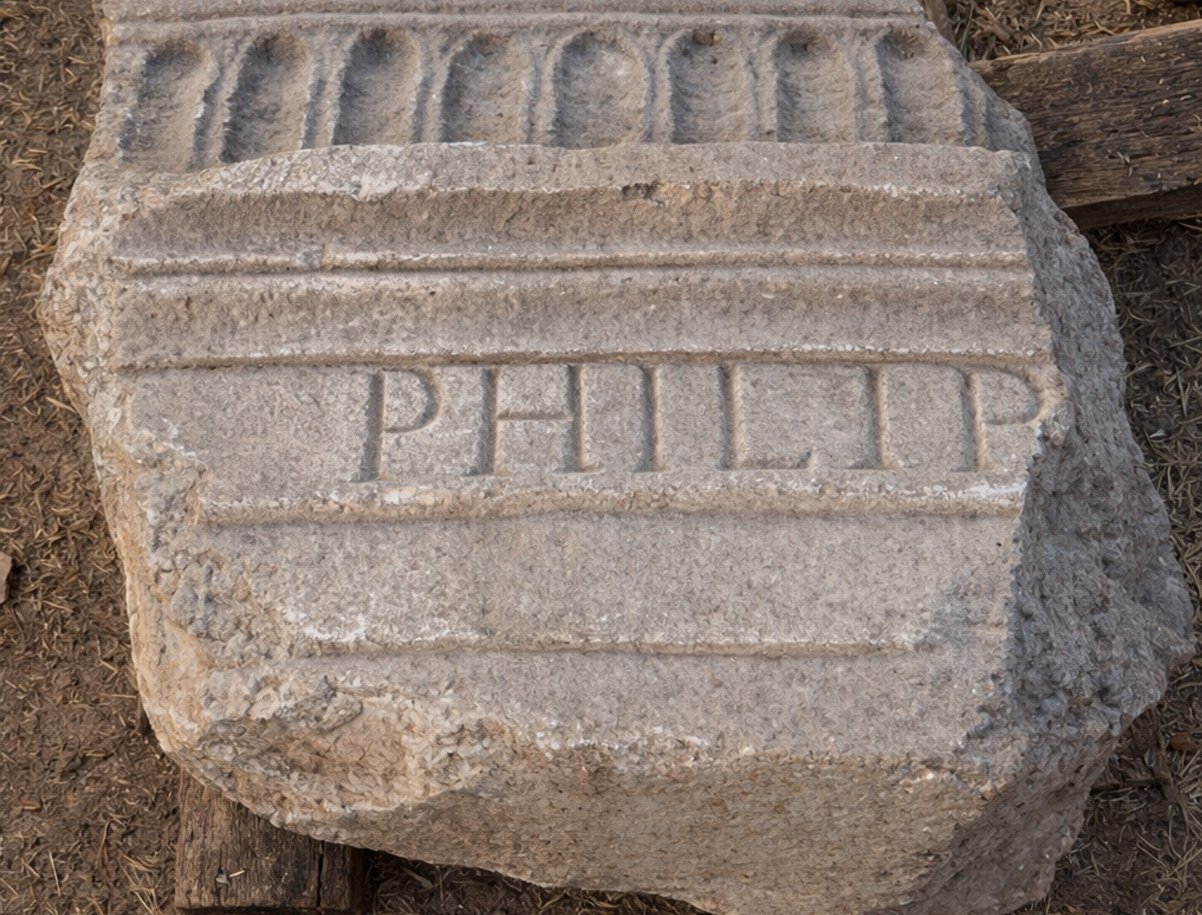
Among the smaller finds from the excavation were fragments of pottery, bronze coins, and metal artefacts, along with an intact marble basin. Particularly noteworthy were two fragments of Latin inscriptions believed to have belonged to the epistyle of the fountain building. One inscription preserves the word “PHILIP,” while the second contains the partially preserved phrase “P·NYMP REI·PVB,” which may relate to a public nymphaeum or fountain.
Perhaps the most striking discovery was a large marble lion sculpture uncovered along the southern decumanus. The lion’s head, which faces to the right and remains remarkably well preserved, is thought to date to the Roman imperial period. However, the sculpture differs stylistically from other statues previously found at the site.
Archaeologists believe this discrepancy may indicate that the fountain complex underwent later remodelling and was decorated with a mixture of earlier architectural elements during a period of historic revival, likely in the early Middle Byzantine era.
The excavation project is funded by the technology company Raycap and is directed by Professor Emeritus Natalia Poulou, with the participation of Associate Professors Anastasios Tantsis and Aristotle Mentzos. The research team also includes doctoral candidates and students from the Aristotle University of Thessaloniki and Université Paris-Nanterre in France.
Researchers say the findings contribute valuable new information about Philippi’s architectural development and the reuse of classical elements in later historical periods.
Sources : alfavita