
In this ‘Behind the paper’ blog post, author Rafael Cabral Borges – a postdoctoral fellow at the Vale Institute of Technology in Belém, Brazil – discusses his paper “Bee community assembly is regulated by functional traits in pristine tropical forest environments“. Rafael explores whether bee communities organise themselves differently in forests and in canga areas, conducting fieldwork in the Amazon, and his passion for bee keeping!
A Portuguese translation of this blog post is available here.
About the paper
The Amazon is under growing pressure from human activities. At the same time, major efforts are underway to conserve what remains and restore what has been degraded. But managing an ecosystem as vast, complex, and extraordinarily diverse as the Amazon requires more than good intentions, it requires a deep understanding of how it is structured and how it functions, so that actions taken today will still be effective in the long term. In this study, we approached this challenge by looking at bee communities in pristine Amazonian environments. Our goal was to understand how bee communities are organised and how they contribute to ecosystem functioning. And by “pristine environments,” we don’t mean only the well-known forests. We also include naturally occurring open vegetation areas, grasslands locally known as cangas, that are abundant in mineral resources and an important component of the landscape heterogeneity in the Amazon.
We asked a straightforward question: do bee communities organize themselves differently in forests and in canga areas? To find out, we looked not only at which species are present (taxonomic diversity), but also at what they do (functional diversity). We analyzed traits such as behavior, nesting habits, and their roles in pollinating local plants. We also examined whether environmental differences between forests and cangas act as filters, favoring certain species and traits over others. What we found was that differences between these habitats became clearer when looking at functional diversity rather than simply counting species. In other words, understanding the role that bees play in the ecosystem revealed patterns that species lists alone could not. Forest environments host a wider variety of bee subfamilies, suggesting that forests act as sources of bee lineages that are able to explore canga areas. This makes forests a resilience buffer for pristine open habitats. Cangas, on the other hand, tend to favor more specialized species. Meanwhile, the more stable and resource-rich forest understory supports a higher abundance of social bees, each with distinct functional traits that contribute to pollination in different ways. Together, these findings show how forests and cangas are functionally connected, and why both are essential for maintaining healthy pollinator communities in the Amazon.
From a conservation perspective, our findings highlight the importance of maintaining open habitat patches, regardless of their size, as long as they remain embedded within a forest matrix. These open areas are not empty gaps in the forest; they support distinct bee communities that are essential for maintaining ecological balance. For restoration, our results show that recovering open habitats alone is not enough. The surrounding matrix must also be considered, because the interaction between open and forest environments is crucial for sustaining pollination and other ecosystem functions.
Overall, our study reinforces a key message: protecting the Amazon is not only about preserving forests, but about maintaining the diversity of landscapes and the diversity of ecological roles performed by species. Incorporating landscape heterogeneity and functional diversity into environmental management, restoration, and biodiversity offsetting plans is essential to achieve lasting conservation outcomes and safeguard ecosystem services.
About the research
To answer our questions, we carried out fieldwork in the Carajás National Forest, a protected area in the eastern Amazon that covers more than 400,000 hectares. This remarkable landscape is a mosaic of dense upland rainforests and the canga ecosystems, which are ironstone outcrops. We selected 16 pristine sites for our study: eight in canga habitats and eight in intact forest. At each site, we walked a 1-kilometer transect, observing flowers and collecting every bee that visited them. We focused on flowers up to 3 meters above the ground, which corresponds to the forest understory in wooded areas and to the main flowering layer in open cangas. Each patch of flowers was observed for five minutes, and all visiting bees were collected for identification and analysis of their traits. This standardized method allowed us to fairly compare bee communities between forests and cangas and understand how these environments shape pollinator diversity and function.
Doing fieldwork in the Amazon is rarely simple. Reaching sampling sites often means traveling long distances on rough roads, dealing with fallen trees that block the way, and spending hours confined inside a vehicle just to get from one point to another. On top of that, there are the constant challenges of heat, humidity, insects, and the risk of tropical diseases. Because of this, building a robust and meaningful dataset in the Amazon is not just a scientific achievement, it is a deeply rewarding experience. It reflects days of patience, resilience, and teamwork in demanding conditions. Seeing the data come together after such effort is a powerful reminder that the hard work in the supported solid science, and meaningful conservation insights. The results of this study were especially meaningful because they point to science-based practices that can guide conservation and restoration planning. But it also brought surprises. At first, we expected that bee communities in open canga vegetation would simply be a smaller subset of those found in forests. In other words, we thought cangas would host mostly the same bees as forests, just fewer of them.
That’s not what we found.
Only part of the bee community in the canga overlaps with the forest community. Much of it is made up of species that likely came from the surrounding forest matrix but are not commonly found in the forest understory where we sampled. This reveals a more complex relationship between these environments than we initially imagined. It is possible that if we had been able to sample bees high up in the forest canopy, we might have found stronger support for our original hypothesis. Forest canopies are known to host very different insect communities from those near the ground. Although canopy sampling was not possible in this study, this is something we are actively working toward in future research. These unexpected findings show how much there is still to learn about how Amazonian landscapes function, and how important it is to keep exploring them from new perspectives.
About the author
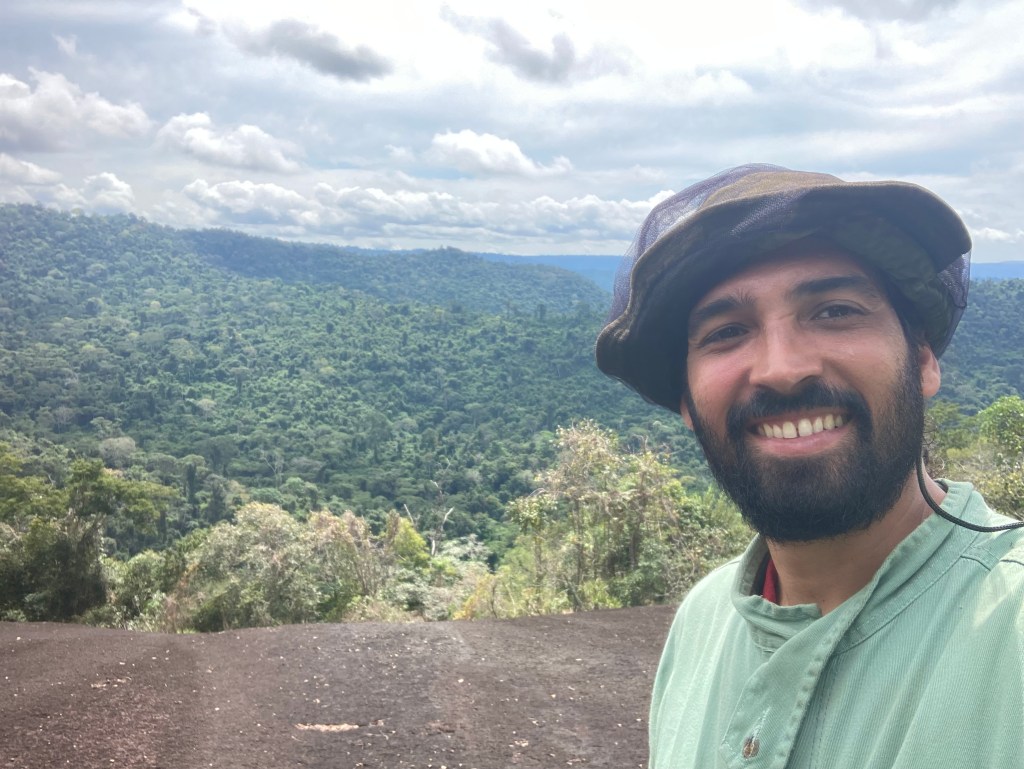
I’m an ecologist from the Amazon, and my curiosity about nature began early in life. I’ve always been fascinated by how living organisms organize themselves to survive, how they interact with one another, and how these interactions come together to form living communities. My first deep dive into ecology focused on species interactions, especially between plants and their pollinators. Over time, I realized that these relationships are part of a much larger story. They help us understand how entire communities are structured, how ecosystems recover through restoration, and how this knowledge can guide effective conservation. More recently, I’ve also started exploring social ecology, looking at the connections between people and nature, and how human decisions shape ecological outcomes. Today, I’m a postdoctoral fellow at the Vale Institute of Technology in Belém (Brazil), where I study how ecological interactions can inform better conservation and restoration practices in the Amazon. Outside of research, I love spending time with my family, going to the beach, playing sports, and caring for my stingless bees. Beekeeping is a special passion of mine because it allows me to connect with nature while sharing meaningful moments with my family. Academia is a demanding profession. I have a deep passion for it, which makes the work a pleasure, but the uncertainty that comes before securing a permanent position can be challenging. One of the biggest bottlenecks in a research career is simply the limited number of positions available. If I could say something to my younger self, it would be this: follow your passion. It is rewarding, and it can lead to contributions that truly make a difference in the world.
